The Cruciform Church
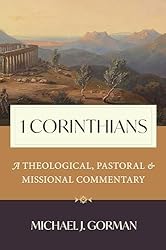
A Feature Review of
1 Corinthians: A Theological, Pastoral, and Missional Commentary
Michael J. Gorman
Hardcover: Eerdmans, 2025
Buy Now: [ BookShop ] [ Amazon ] [ Kindle ]
Reviewed by Jeff Kennon
It was the early 2000’s. I had finally settled on a research topic for a degree I was pursuing at Southwestern Baptist Theological Seminary. It had been a painstaking decision as every topic seemed to be of interest to me. But I had to pick a path. My topic? It was the practical implications of a theology of the cross. Now at that time, I never dreamed that such a topic would lead me to discover the idea of cruciformity. I had never really heard the word before. Or if I did, it didn’t register. However, Michael Gorman’s book, Cruciformity: Paul’s Narrative Spirituality of the Cross, changed all of that.
So as a result of being introduced to Cruciformity by Gorman several years ago, I have continued to read his work. Therefore, when I read that he was writing a commentary on 1 Corinthians, I knew I had to grab a copy, regardless of whether I ever got a chance to review it or not. Now of the writing of commentaries, there seems to be no end. I’m not sure how one keeps up with them all. Or even if one should. But Gorman’s work has always been something I have trusted and benefitted from. So as a result, I felt it important to see what he had to say about 1 Corinthians (Gorman also has written a commentary on Romans with the same format and aim as this one on 1 Corinthians).
In order to get a grasp on Biblical commentaries and their accessibility, it’s important to understand that they range from the critical to the devotional. That is, some are written from a more scholarly stance while others lean toward a more general audience (no need for understanding biblical languages, etc.). When it comes to Michael Gorman’s 1 Corinthians: A Theological, Pastoral & Missional Commentary, its subtitle alone hints at the type of reader that is being targeted. “This volume is a midlevel commentary that has been prepared especially for pastors, students, and laypeople…that stresses theological content and considers [1 Corinthinians’s] spiritual, pastoral, and missional implications for today,” writes Gorman (xvii).
As one flips through the pages of Gorman’s work, it’s easy to notice the expected sections of wading through the biblical text. But in addition, one will clearly see that theological and missional reflections are also included. These are found at the end of each outlined section of 1 Corinthians (Gorman uses his outline of the letter to not only guide the commentary but to help readers pick up the major themes that Paul is trying to get across). These reflections and questions are intentionally designed for one to pull the contents of 1 Corinthians beyond the page and into the day to day events of life and ministry. Also included at the end of these divisions is a wealth of other resources to consult. I personally found the inclusion of further books to examine extremely helpful.
Personally, I discovered two overall guiding principles emerging from Gorman’s work; both of which are instrumental in guiding one to understand 1 Corinthians. First, is the mark of the church. That is, the church is called to be “one, holy, catholic, and apostolic,” as is written in the Nicene Creed. Gorman points out that though some have narrowed the scope of 1 Corinthians to just one of these marks, specifically unity or holiness, it is necessary for all to be included. Granted these marks were written much time after Paul sent this letter to Corinth, but Gorman writes that “using [these marks] as a lens which to view 1 Corinthians allows us to perceive things we might not otherwise see” (68).
One example of using the marks of the church as a lens to see the letter is found at the end of 1 Corinthians. In Paul’s concluding remarks, the Corinthians are exhorted once again to love one another—1 Corinthians 13 is of course primary in Paul’s admonition to love. Now the church in Corinth had a host of problems. However, as Gorman aptly points out, though disunity, pride, sexual sin, and other issues are named, a lack of love for one another is most likely at the heart of them all (416). So for the church in Corinth to bear the marks of “one, holy, catholic, and apostolic,” Christlike love has to be central. It works like this: love is a must for unity. But to love is also to lead a life set apart from the honor seeking ways of the world. And this holy love that is commanded by Paul is not just for the Corinthians alone. It is a command for every church. And this means that it is a command which leads to developing a heart for all nations to know the God who rescues and restores.
The second proposition that guides Gorman’s work here in 1 Corinthians is no doubt, the idea of cruciformity. Now Gorman has written much on cruciformity, and as a result, for him and others (this reviewer included) it’s become an important lens through which to understand all of Scripture. Yet when you read this commentary, a cross-shaped life is not forced into the conversation, but instead is derived from the heart of Paul himself. Paul is quick to point out in 1 Corinthians 1:18-2:1-5 that the cross is counterintuitive and countercultural in regards to both message and method (111-131). And since this is so, then Paul must remind those in Corinth that they are not just saved by the cross, but to the cross. This is true spirituality empowered by the power of the resurrection. Gorman writes that Paul “wishes the Corinthians to become a resurrectional cruciform charismatic community: a Spirit-filled church in the shape of Christ’s cross” (33).
As a habit, I rarely read straight through many commentaries (whether this is good or bad I don’t know). Generally I bounce around quite a bit. But since I was signed up to review this one on 1 Corinthians, I naturally read it through. In doing so, I discovered the academic depth that Gorman brings to his readers. He is not afraid as a scholar to tackle the weighty issues that 1 Corinthians brings though for some, this might mean a second reading of various sections. But Gorman is also not shy at hoisting up 1 Corinthians as a Pauline letter that has tremendous practicality for any church. To be the church, we need to wrestle not only with Paul’s theology, but the necessary praxis of it as well. And I feel that this commentary by Gorman helps us do just that. Thus, anyone who decides to dive into this 1 Corinthian study will be glad they did.

Jeff Kennon
Jeff Kennon lives in Lubbock, Texas where is the director of the Baptist Student Ministries at Texas Tech University. He is also the author of The Cross-Shaped Life: Taking On Christ’s Humanity, published by Leafwood Press. You can find him online at www.jkennon.com.
 Reading for the Common Good From ERB Editor Christopher Smith "This book will inspire, motivate and challenge anyone who cares a whit about the written word, the world of ideas, the shape of our communities and the life of the church." -Karen Swallow Prior Enter your email below to sign up for our weekly newsletter & download your FREE copy of this ebook! |
 Understanding Christian Nationalism [A Reading Guide]
 |
 Most Anticipated Books of the Fall for Christian Readers! Most Anticipated Books of the Fall for Christian Readers!
|
 Hilarious One-Star Customer Reviews of Bibles Hilarious One-Star Customer Reviews of Bibles |