
 A Prayer That Rolls the Stone Away
A Feature Review of
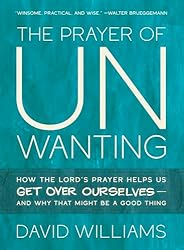
The Prayer of Unwanting: How the Lord’s Prayer Helps Us Get Over Ourselves–and Why That Might be a Good Thing
David Williams
Paperback: Broadleaf Books, 2025
Buy Now: [ BookShop ] [ Amazon ] [ Kindle ] [ Audible ]
Reviewied by Ope Bukola
I love reading books about prayer. As I sit to write this review, I can see at least four books on my shelves that are collections of, or reflections on prayer. Prayer seems like it should be the easiest spiritual discipline, yet it often proves to be the most challenging. I grew up in a Christian household where “Let’s pray” was practically a family motto. Yet, when I get up each morning to pray, it can still feel surprisingly difficult. In the last year, I’ve started using the Lord’s prayer as a kind of “warm-up” to my prayer time. Sometimes, in reciting the Lord’s prayer slowly, I am reminded of who God is, and from there flows prayer that focuses not on my petitions, but on God’s goodness, provision, and sovereignty.
Williams begins the book by telling the story of a bestselling book that instructed Christians to pray a somewhat obscure prayer that would supposedly bring about all sorts of supernatural gifts and blessings. He describes how the Lord’s prayer – the way Jesus taught us to pray – is often said on autopilot, without the magical appeal of a prayer that promises to get us everything we want. Instead of a prayer designed to give us what we want, it “changes the heart of our wanting.”
Each chapter offers a brief reflection on one line of the Lord’s prayer. This is a very short but impactful read that invites us to think deeply about familiar words. If I have any critique, it’s that the chapters sometimes feel too short, as if Williams opens important doors without fully exploring what’s behind them. But I suspect he wants readers to devote time to their own inner lives, rather than on his words.
Williams spends just four pages on “Lead us not into temptation,” yet I found myself journaling and thinking about this line for days. He writes: “Temptation is that thing that draws us towards what we want the very most in this moment, towards what we want the most right now…That wanting has nothing to do with who we are trying to become as a person.” This reframing of temptation and evil as internal rather than external – the “shadow of our own soul” – led me to interrogate my own momentary desires and the ways they are frequently at odds with my aspirations.
The book concludes with a reflection on “Amen,” and Williams writes, “We say AMEN as we pray that our actions in the present will be altered, our lives shaped to the form of life Jesus lived. It is a prayer that rolls the stone away and sets a bright hope to guide us towards resurrection. Let that be so, for you and for me. AMEN.”
This is the heart of the matter. When we pray the Lord’s prayer, we’re saying “let it be so.” Come Lord Jesus and make a new life in me. Transform me and bring about a newness in how I see God, myself, and the things that I desire.
My aspiration for prayer is to have an experience that is transcendent, to feel and know a personal bond with God. Yet every morning I fight my desire for efficiency, my brain’s relentless drive to distraction, and my inability to be present. Ultimately, Williams reminds us that temptation comes from within, and we need the Holy Spirit to help us persist every single day, in prayer and beyond. We need God’s help to become who he wants us to be, and God knows we need his help. That’s why he’s given us this prayer.
For anyone seeking to deepen their prayer life or breathe new meaning into familiar words, I highly recommend this book. It’s best digested slowly – don’t be tempted to read through the chapters quickly. Take one a day or one every few days, digesting and reflecting on the questions. This would be an excellent volume to read as a family or in community, using the thoughtful discussion questions included at the end of each chapter.

 Reading for the Common Good From ERB Editor Christopher Smith "This book will inspire, motivate and challenge anyone who cares a whit about the written word, the world of ideas, the shape of our communities and the life of the church." -Karen Swallow Prior Enter your email below to sign up for our weekly newsletter & download your FREE copy of this ebook! |
 Understanding Christian Nationalism [A Reading Guide]
 |
 Most Anticipated Books of the Fall for Christian Readers! Most Anticipated Books of the Fall for Christian Readers!
|
 Hilarious One-Star Customer Reviews of Bibles Hilarious One-Star Customer Reviews of Bibles |