
 Toward a Faithful Parenting Journey
A Feature Review of
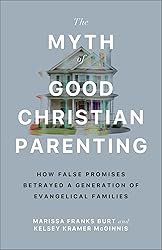
The Myth of Good Christian Parenting:
How False Promises Betrayed a Generation of Evangelical Families
Marissa Franks Burt and Kelsey Kramer McGinnis
Paperback: Brazos Press, 2025
Buy Now: [ BookShop ] [ Amazon ] [ Kindle ] [ Audible ]
Reviewed by Rachel Lonas
“Many Christian parenting experts assume that all successful families look the same.”
From the outset of The Myth of Good Christian Parenting, Marissa Franks Burt and Kelsey Kramer McGinnis identify a major error in many Christian parenting books—flattening the diversity of the human experience and the richness of the gospel story into a single cultural and emotional mold.
This is something I know.
They continue, “Resources presume a nuclear family, with two married parents, so there is rarely mention of single, divorced, or widowed parents—or extended family members taking on parental roles. Most authors don’t address neurodivergence or disability, even adjusting for awareness at the time of writing” (4).
My childhood home knew the challenges of both neurodivergence and disability. Many days we were just trying to survive school struggles and my sister’s doctor appointments. Christian resources with one-size-fits-all language would only have reminded us that we did not meet their standards.
Given my family’s history, I knew that this book, cataloging not just ignorance but ecclesiastical and criminal abuses of power toward children, was going to be an important resource. The authors are right to say that this is a long overdue conversation.
Burt and McGinnis do their homework, including extensive footnotes along with a how-did-we-get-here overview. They break down well-known Christian parenting book themes using research and others’ testimonies. Presenting their work as impartially as possible, they avoid their own stories, instead casting a wide and gracious net. Christian parents – both new (looking for guidance) and old (looking for relationship repair) – as well as the disillusioned (affected by harmful teachings) should find much value here. The authors’ fair-mindedness invites even skeptics to give them a hearing.
Burt and McGinnis point out that the narrow views of children’s personalities and behavior found in the books they survey rise from a lack of cultural and socioeconomic diversity: most of these books are by white evangelical males whose fear-mongering “background, experience, ideologies, and assumptions shape their parenting advice” and who lack credentialing in evidence-based methods of child development (4).
Familiar names in evangelical circles—Dobson, LaHaye, Ezzo, Baucham, Tripp, Wilson, Hamm, Pearl, Piper, Driscoll, Elliot, MacArthur, etc.—all make appearances here. Burt and McGinnis single out James Dobson in particular, pointing to his early tutelage and book endorsement from Paul Popenoe, an atheist and eugenicist who wrote popular marriage counseling books promoting the idealized nuclear family of white, middle-class culture. They note that Dobson’s works include some psychology but often veer into gender-essentialism, white supremacy, and deeply questionable (sometimes hyper-sexualized) conclusions and recommendations (21).
Burt and McGinnis argue that the authors of this era create subjective definitions of terms such as “biblical,” “sin,” “selfishness,” “obedience,” “pride,” “submission,” “discipline,” and “gospel.” Many share a pattern of black-and-white thinking. Parenting is seen through the lens of the prosperity gospel and generational legacy: in other words, if you follow these rigorous plans faithfully, you’ll receive parenting rewards; “violate the principles, forfeit the blessings” (5).
Central to most of the books surveyed is corporal punishment. As an educator who works with children, I wanted to look away from this chapter. One author they researched wrote about spanking, “It is better for children to carry a few temporary marks on the outside than to carry within them areas of disobedience and wrong attitudes that can leave permanent marks on their character” (133). This form of parenting creates enmeshment, the psychological concept of not knowing where you end and another person begins. Through control and suppression, a person is tethered to someone else’s needs even after he or she has left home. Testimonies collected in the book bear witness to the religious scrupulosity, suicidal ideation, and self-loathing the interviewees developed from experiencing daily scrutiny and condemnation as a child.
The quotations and stories from The Myth of Good Christian Parenting raise reasonable questions: Would we allow anyone who made such claims in our physical homes? If not, why should we accept their authority in our homes through their resources? Do the fruits of their labor as “sin diagnosticians” indicate that these authors care about parents and follow a loving Christ, or do they reveal building a “content empire” as a way to retain power over others?
As parents do we consider behaviors like whining and inattentiveness the acts of a sinful tyrant toddler or just a dependent, powerless child trying to get their needs met? Does our child’s behavior square with observed patterns of child development? Do they have neurological or biological needs to be considered? Is our child’s behavior being held to a standard that we ourselves are not held to?
As a mother of four daughters, I know that insisting or even insinuating that a young woman’s highest or only goal is marriage and motherhood, rather than one of many good paths, leaves them susceptible to harm. It also curtails their ability to plan for the future, particularly if their spouse dies, abandons, divorces, or abuses them (63).
I have grieved with friends whose testimonies mirror the book’s double burden of parental and religious enmeshment. These outwardly funny, successful, and compassionate adults describe an arrested development in their 40’s— still feeling as if they have little agency in their lives and thinking God may be mad at them for not being dutiful or hypervigilant enough about their spiritual motivations.
Burt and McGinnis also analyze the present social media age, considering how and why women become influencers focused on aesthetics and gendered roles. They note that many conservative women turned to online pulpits because they had more freedom to share and monetize there than in their own churches (44). In this way, their platform is similar to the men or couples who wrote the books surveyed. These books encourage parasocial relationships, a false intimacy with their followers, to increase their brand or promote their message or product (43). In some cases, this is a proof-of-concept “tradwife” gospel—how a hard-working mama can have it all including a thriving, disciplined Bible study life (if she has middle class values) (41). In this way, The Myth of Good Christian Parenting raises another question: what Kingdom joys of local, safe presence and trust do we miss out on when we look to faraway experts to fill a void, solve our problems, or sympathize with our woes?
Sadly, many local churches have bought into the “expert” approach to ministry, so what happens online or in best-selling books can affect us even if we don’t partake of those things ourselves. I have been in churches that shared, taught, and recommended these parenting resources. I have been given these parenting resources at all my baby showers. Since they seem unavoidable, we need to bring our critical thinking skills to bear.
A good place to start is by inspecting labels. Giving a blanket classification of everything as “biblical” is similar to arbitrary marketing on cereal boxes claiming “all natural” or “healthy.” How do we evaluate these claims and not succumb to the branding? Burt and McGinnis do not give new recommendations. Instead, they provide guided invitations to curiosity—around family-of-origin wounds, child development and psychology, who counts as an “expert”, and what Jesus teaches—leaving it to readers to do some soul (and Scripture) searching to discern how best to address these topics with gentleness and health.
To that end, they provide a valuable rubric in the appendix to evaluate Christian parenting books. Each category (depiction of children, discipline, theology, tone, etc.) is evaluated with a “green light”, “yellow pause”, or “red flag” (198). When you total up the colors you have determined in those categories for your resource, you can make a more informed decision on how much importance it should have in your home or as a recommendation to others.
The Myth of Good Christian Parenting is a reminder for all of us that there are no formulas for great outcomes in this life. We can only follow Jesus with faith, compassion, curiosity, and kindness. The authors expose abusive and harmful resources but always with an eye toward helping the reader to have a faithful parenting journey without so much pressure to avoid “doing it wrong.”

Rachel Lonas
Rachel Lonas is a writer and educator specializing in literature and composition. She enjoys her work in community development as a librarian and running her own tutoring business, as well as watercoloring and gardening. She lives in Chattanooga, Tennessee, with her husband, Justin, and their four daughters.
 Reading for the Common Good From ERB Editor Christopher Smith "This book will inspire, motivate and challenge anyone who cares a whit about the written word, the world of ideas, the shape of our communities and the life of the church." -Karen Swallow Prior Enter your email below to sign up for our weekly newsletter & download your FREE copy of this ebook! |
 Understanding Christian Nationalism [A Reading Guide]
 |
 Most Anticipated Books of the Fall for Christian Readers! Most Anticipated Books of the Fall for Christian Readers!
|
 Hilarious One-Star Customer Reviews of Bibles Hilarious One-Star Customer Reviews of Bibles |