
 Accepting the Invitation to Uproot the Misogyny in Me
A Feature Review of
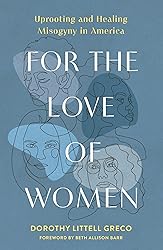
For the Love of Women: Uprooting and Healing Misogyny in America
Dorothy Littell Greco
Paperback: Zondervan, 2025
Buy Now: [ BookShop ] [ Amazon ] [ Kindle ]
Reviewed by Jonathan P. Walton
Following Jesus requires growth, change and oftentimes, discomfort. And at the end most days, I am simply not interested in that. Fortunately, Mary, the mother of Jesus, is a great model for how to respond when God interrupts our paths with a holy invitation. When confronted with the impossibility of being chosen by God to birth the Messiah, her response was “may it be as you say”.
I had a holy encounter with Dorothy Littell-Greco last summer and I am joyfully struggling with its implications for marriage, parenting, and witness in the world. Because on the other side of putting the words that she has written into practice is freedom not just for my daughters, my wife and the women around me but for men including myself. I was struck by Dorothy’s clear eyed, Christ-centered assertion that I could be emotionally present, partner well, and love my wife as God intended. I was skeptical but now I know it was a call to leave misogyny behind, be healed and walk into a different kingdom. I’m so glad I said yes.
I met Dorothy Littell-Greco unexpectedly at a retreat with my family. My wife, our two daughters and 14 other families went to Toah Nipi in hopes of building a more solid foundation for our faith with and around other families. At best it is a wonderful time of connection and encouragement. At worst, it is high quality, low cost babysitting and time away from New York City. Little did I know, I was about to have some core beliefs about myself and the world challenged and be lovingly oriented away from unconscious misogynistic tendencies that have shaped me since childhood and kindly invited toward a more just and loving Kingdom of God.
Dorothy Littell-Greco is a writer, speaker, and facilitator with years of professional and personal experience that informs and animates this powerful book. Story, statistics and scripture ground us in the difficulties of this world, the promise of the kingdom of God and the awful and awesome experiences of both respectively. For the Love of Women: Uprooting and Healing Misogyny in America features nine chapters:
Chapter 1: The Air We Breathe: Misogyny’s Persistence and Prevalence
Chapter 2: It’s All in Your Head (or Maybe Your Uterus): Misogyny in Healthcare
Chapter 3: Unseen, Unappreciated, and Underpaid: Misogyny in the Workplace
Chapter 4: Making It Legal: Misogyny in the Government
Chapter 5: Behind the Screens: Misogyny in Media and Entertainment
Chapter 6: In the Flesh: Misogyny in Sexual Relationships
Chapter 7: Baptizing Sin: Misogyny in the Church
Chapter 8: Naming Our Needs and Broken Places: Healing Misogyny’s Wounds
Chapter 9: Imagine If: Writing Misogyny Out of the Narrative
The most important thing to grasp starting the book is the definition of misogyny and like other controversial topics, we often try to make it as narrow as possible at the expense of those who are suffering so that we don’t have to confess our guilt and complicity. This does not have to be a point of constant contention but is lovingly confrontational and models the approach that I appreciate so much in the book. Dorothy says hard things clearly with searing evidence yet does not condemn or exclude. Men and women alike are suffering and thus all people are in need of healing. Misogyny to Dorothy is “the persistent insidious belief that men’s ideas, wants, needs, and experiences are more important than women’s and that political, religious, and social systems as well as intimate relationships, should uphold this principle. This belief system subsequently influences laws, practices, and ethos of a given culture, eventually harming everyone – especially women and children.”
Though Dorothy goes on to explain how pervasive, evil and adaptable misogyny is, she proclaims and illustrates how it is not inevitable. God did not create women to live beneath men and though the public face of misogyny is women, we must grapple with the reality that misogyny’s first victim is the man who believes his identity and worth comes from domination and control. It is from this terrible, unfaithful lie that so much evil flows. And fortunately can be undone. But first, we have to understand the depth of the problem and its destructive impacts. Too often, we jump to solutions without comprehending the suffering so our answers are too shallow, insensitive and short-sighted. As aforementioned there will be discomfort, but for the sake of healing, it is worth it.
Media, relationships, healthcare, the workplace – these are the places that ideas take flight and if we are to change the path that we are on, there must be methodical engagement. And Dorothy does that with kindness, clarity and the appropriate terseness that gets to the point and doesn’t hide, sugarcoat or gloss over the deep pain hidden in plain sight. Women should not need men to cosign for their credit cards, women can run marathons and play 5 on 5 basketball. Misogyny encourages sexual male entitlement in intimate spaces, stunts our emotional lives and encourages us to abuse and disempower others. God cannot fix what we are unwilling to face and I am grateful that Dorothy faces the suffering in our world head-on because she holds a gospel story that is big enough to defeat what often feels insurmountable.
Finally, what I find most helpful about this book is its handling of complexity. Dorothy knows that she is a college educated, white woman in the United States and ensures inclusion of diverse voices because we not only live in a misogynistic culture but a racist one. Again she writes clear, genuine, well-cited work that is pastoral, prophetic, wise and informative while being accessible, not accusatory. And as a facilitator myself of difficult conversations, I know this is hard to do. Yet, she does it so well.
So, if you are thinking to yourself, should I read this book? The answer is yes. And if you are a man thinking, should I read it first myself and then share it with ________? I think the answer might be, to take the brave step to read it with a group of men and women and consider how we might leave misogyny behind to be whole people and co-create a renewed world where it is as God intended in the beginning.

Jonathan P. Walton
Jonathan P. Walton is a writer, speaker, and facilitator at the intersection of faith, justice, and emotional health. He leads Beauty and Resistance Cohorts, writes The Crux on Substack, and is a senior resource specialist for InterVarsity USA focusing on political discipleship and civic engagement. He has written five books, including Twelve Lies that Hold America Captive and Beauty and Resistance (November 2025). He has been featured in Red Letter Christians, Christianity Today, Outreach Magazine, Christians for Social Action and more. Follow him at Instagram, @jonathanpanwalton.
 Reading for the Common Good From ERB Editor Christopher Smith "This book will inspire, motivate and challenge anyone who cares a whit about the written word, the world of ideas, the shape of our communities and the life of the church." -Karen Swallow Prior Enter your email below to sign up for our weekly newsletter & download your FREE copy of this ebook! |
 Understanding Christian Nationalism [A Reading Guide]
 |
 Most Anticipated Books of the Fall for Christian Readers! Most Anticipated Books of the Fall for Christian Readers!
|
 Hilarious One-Star Customer Reviews of Bibles Hilarious One-Star Customer Reviews of Bibles |