The first half of 2025 promises a ton of excellent new books! Here are 60 of our most anticipated books of Spring 2025 for Christian Readers…
These anticipated books of Spring 2025 (released in the first half of the year) wrestle with some of the deepest challenges of our day, and will orient us toward faithful living in the present and in years to come.
*** Love Books? Sign up now for our email newsletter and get all the best book news, reviews, and sales in your inbox!
(PLUS, get a free ebook for signing up…)
[ TOP 10 – Part 1 ] [ Top 10 – Part 2 ]
[ Theology ] [ Formation ] [ Church ]
[ NonFiction ] [ Literature ] [ Biography / Kids ]
[ Coming in 2025! ]
Page 2: TOP 10 – Part 2
(In Alphabetical Order by Author’s Last Name)

The Affections of Christ Jesus: Love at the Heart of Paul’s Theology
Nijay K. Gupta
(Eerdmans, February 20)
Pauline scholars have long debated the so-called center of Paul’s theology, focusing on themes like justification by faith, reconciliation, union with Christ, and the apocalyptic triumph of God in Christ. In this innovative study, Nijay Gupta offers a new perspective that emphasizes Paul’s understanding of love at the heart of the gospel he preached.
Through careful examination of the historical, cultural, and linguistic milieu in which Paul was working, Gupta identifies what is unique and important in Paul’s theology of love. In so doing, Gupta helps readers develop a deeper appreciation for the extent to which love permeates Paul’s understanding of the triune God, the gospel, the community, and the mission and lifestyle of God’s people.

Christ in the Rubble: Faith, the Bible, and the Genocide in Gaza
Munther Isaac
(Eerdmans, March 27)
In this impassioned and incisive book, Munther Isaac challenges mainstream Christians’ uncritical embrace of the modern State of Israel. Speaking from his unique vantage point as a prominent Palestinian Christian pastor and theologian, he proclaims a truth that is rarely acknowledged in Christian circles: Israel’s campaign to eliminate the Palestinian people did not begin after October 7, 2023. Rather, the campaign is a continuation of a colonial project with nineteenth-century roots that has, since 1948, established systems of entrenched discrimination and segregation worse than South Africa’s apartheid regime.
Writing from Bethlehem with close-up knowledge of conditions on the ground, and rooted in a commitment to nonviolence and just peace, Isaac urges readers to recognize that support for Zionism’s genocidal project entails a failure to bring a properly Christian theological criticism to bear upon colonialism, racism, and empire. He calls on Christians to repent of their complicity in the destruction of the Palestinian people. And he challenges them to realign their beliefs and actions with Christ—who can be found not among perpetrators of violence, but with victims buried under the rubble of war.

Kitchen Hymns: Poems
Pádraig Ó Tuama
(Copper Canyon, January 28)
Written by the engaging host of the popular show, Poetry Unbound, the poems of Kitchen Hymns are finely honed melodies of survival—shaped with both humor and anger, force and conviction.
Pádraig Ó Tuama’s Kitchen Hymns opens with a question: “Do You Believe in God?” — but the bee, “gone extinct,” cannot answer, and the grass calls believe “a poor verb.” This collection trades belief for language, and philosophy is grounded in form and narrative. Kitchen Hymns is structured like a ghost mass, where even if God is a “favorite emptiness,” longing still has things to say: Jesus and Persephone meet at Hell’s exit and discuss survival; someone believes more in birds than belief; hares carry messages from the overworld to the underworld. A study in lyric address, Kitchen Hymns speaks to a shifting “you”: an unknown you; the strange you; a lover, a hated other; the you of erotic desire; the you of creation and destruction. Large themes are informed by and contained in a poetics of observation, humor, trauma, dialogics, lament, rage and praise. Delivered in finely honed melodies, shaped with force and conviction, Kitchen Hymns “reckon[s] with the empty,” and becomes “busy with a body / not a question.”
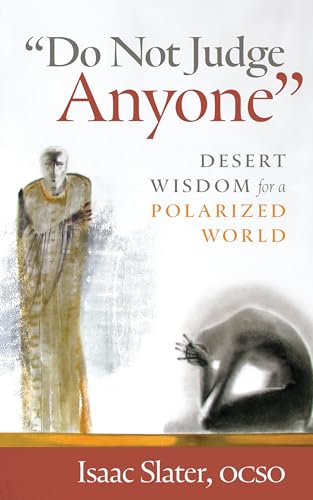
“Do Not Judge Anyone”: Desert Wisdom for a Polarized World
Isaac Slater, OCSO
(Liturgical Press, April 15)
A monastic approach to everyday living that applies Jesus’s teaching of radical non-judgement as a balm for the polarized environment commonly found in the Church and the world today.
Too often Christianity has been hijacked by the superego and the good news of grace compromised by fear and the rationalization of violence. In “Do Not Judge Anyone” Cistercian monk Isaac Slater reflects on the desert fathers’ teachings and practice of not judging with a focus on contemporary life. Interweaving sources from East and West, ancient and modern, Slater finds profound points of contact between the first monks and figures like Dostoevsky, Simone Weil, and in the teaching and witness of Pope Francis. “Do Not Judge Anyone” offers a radical, refreshing, and deeply hopeful vision of the gospel for the twenty-first century.
Following closely Jesus’s injunction to “Stop judging!” the first Christian monks strongly emphasized the practice of not judging others as central to the gospel ethos. Through captivating and sometimes enigmatic sayings and stories of the desert fathers, Slater shares a monastic approach to everyday living that applies Jesus’s teaching of radical non-judgement as a balm for the polarized environment commonly found in the Church and the world today.

Here: A Spirituality of Staying in a Culture of Leaving
Lydia Sohn
(Convergent Books, February 25)
A contemplative guide to finding satisfaction right where you are, by understanding what it is within us that leads to dissatisfaction and creating long-lasting fulfillment—inspired by the ancient Christian tradition of Benedictine stability.
“A challenging spiritual invitation—one that we definitely need.”—Shannon K. Evans, author of The Mystics Would Like a Word
Lydia Sohn was a serial burn-it-down-and-make-a-fresh-start girl until, when in her late twenties, she encountered the Rule of St. Benedict with its vow of stability, and her world was transformed. Sohn took a pause to consider what she wanted out of life—identity, purpose, community—and had a lightbulb moment: Everything she needed to live the life she desired was already within her reach.
Here pushes back against our age of constant reinvention and the cultural message that we should do whatever it takes to get wherever we want to go. Instead, Sohn’s message is the opposite: stay. Stay and cultivate the immense potential and beauty that currently lies dormant within your circumstances.
Sohn understands the allure of nomadism. A nomadic life would protect us from the stress of relational conflicts that inevitably arise when we’re caught in the intricate web of commitments. But the restlessness, FOMO, and disappointment we’re trying to escape always come along for the journey. That’s because they’re not the result of our circumstances; they reside within us.
Braiding personal narrative and spiritual reflection,Here inspires readers to both embrace and transform their circumstances through commitment and stability—in order that they might find true contentment right where they are.
<<<<< PREV. PAGE |
NEXT PAGE >>>>>
ADVERTISEMENT:
 Reading for the Common Good From ERB Editor Christopher Smith "This book will inspire, motivate and challenge anyone who cares a whit about the written word, the world of ideas, the shape of our communities and the life of the church." -Karen Swallow Prior Enter your email below to sign up for our weekly newsletter & download your FREE copy of this ebook! |
 Understanding Christian Nationalism [A Reading Guide]
 |
 Most Anticipated Books of the Fall for Christian Readers! Most Anticipated Books of the Fall for Christian Readers!
|
 Hilarious One-Star Customer Reviews of Bibles Hilarious One-Star Customer Reviews of Bibles |