
 Building Better Belief Systems

A Feature Review of
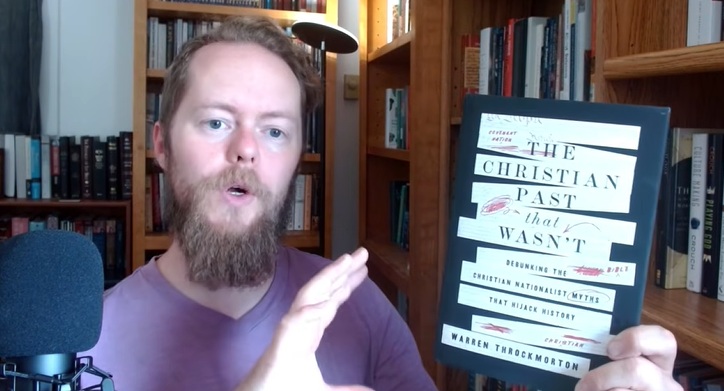
The Christian Past That Wasn’t: Debunking the Christian Nationalist Myths That Hijack History
Warren Throckmorton
Hardcover: Broadleaf Books, 2026
Buy Now: [ BookShop ] [ Amazon ] [ Kindle ] [ Audible ]
Reviewed by Gina Dalfonzo
Warren Throckmorton’s new book, The Christian Past That Wasn’t, is an exhaustive treatment of Christian nationalist myths about the founding of the United States. It ought to be. He’s practiced writing it for sixteen years.
It started in 2010, as Throckmorton explains, when he came across the work of the American Family Association’s Bryan Fischer. He was disturbed to read Fischer’s claims that “only Christians have First Amendment rights and that the free-exercise clause of the Constitution meant to fully protect the rights of only Christians, not those who adhered to other religions”—so disturbed that he began researching and writing about the historical sources that proved Fischer wrong.
Throckmorton isn’t a historian—he’s a retired professor of psychology at Grove City College. But as a Christian and as an American, he felt called to dispute statements that he saw as “both unconstitutional and reeking of religious arrogance.” And he kept at it long after the AFA agreed to take down Fischer’s article, developing a second career as a “part-time history fact-checker.” Via blog posts, podcasts, and books, Throckmorton keeps challenging the Christian nationalist doctrines that hold millions of Americans in thrall.
His first book, Getting Jefferson Right (co-authored with Michael Coulter), concentrated on the actual beliefs, as opposed to the beliefs now widely attributed to him, of one particular Founding Father. The Christian Past That Wasn’t, timed to coincide with the 250th anniversary of the nation’s founding, deals more broadly with that founding and the Christian nationalist myths that have grown up around it. Through his careful reviewing of the founding documents and much related material, Throckmorton demonstrates that concepts like the separation of church and state carry much more weight than today’s Christian nationalists would have us believe.
Throckmorton takes us through the myths and the historical realities, pointing out where and how and to what extent they differ. Quoting from the historical records, he shows that certain public prayers, said to have taken place in Congress and on the battlefield, never actually happened; that certain quotes about the importance of governing by the Ten Commandments have been faked; that certain founders widely hailed as Christians were, to put it mildly, unorthodox in their religious beliefs and rarely attempted to apply those beliefs directly to government. Throckmorton acknowledges that religion did play a role in the lives and words of several founders, but he shows that for every true story about that role, there are numerous false ones.
The further we follow him on this journey, the more difficult it becomes to use the euphemism “myths” for what we’re seeing. The bald truth is that Christian nationalism is a movement that thrives on telling lies. It lies that the Founding Fathers intended the United States to be a “Christian nation.” It lies about the founders’ own personal beliefs and how those beliefs led them to operate. It lies about their views on everything from slavery to education.
Throckmorton’s training and experience in psychology have helped him to understand the disconcerting discoveries he’s sharing with us. “As a retired psychology professor, I know the power of myth, the way questionable theories and ideas can flare up in times of crisis and confusion,” he explains. “I know how we long for stories that help us make sense of the world, and I understand the power of a good story when we want that story to be true.” He further understands “that natural human desires for security lead us to seek a sense of safety by following our tribes and in-groups.” But despite that understanding—or perhaps because of it—Throckmorton gives no quarter to the spinners of myths that have deceived so many people, from R. J. Rushdoony to David Barton and many others. He knows too well the damage those myths, or lies, have done.
For one thing, our beliefs about the past have grave implications for the way we treat each other in the present. When we spend so much time trying to square slave-owning, the theft of land from Native Americans, and other brutal acts with the supposed devout Christian faith of those who committed them, our view of both the faith and the oppressed minority groups becomes warped. We can end up believing that our own professed faith has nothing of value to teach us about how believers should treat such groups, as demonstrated by Bryan Fischer’s egregious argument for depriving non-Christians of their rights.
Throckmorton’s own understanding of Christianity makes him angry at the Christian nationalists’ lack of honesty—which, lest we forget, is supposed to be a foundational Christian virtue. The painful irony is that this movement, obsessed with making everything in America “Christian,” displays in every action its own lack of Christianity. It’s simply a power grab dressed up as Christianity.
Despite Throckmorton’s ability to keep a measured tone—most of the time—it’s difficult to get through this book without catching some of that anger and frustration from him. I write this as one who has history with several of the organizations and individuals he mentions. Over the years, I’ve come to see more clearly what those places and people were really about. But watching Throckmorton plumb the depths of their deception, I don’t just feel angry—I feel betrayed. And all the more because I am both a Christian believer and an American who still believes in the potential of this country, despite many grievous errors and setbacks, to live up to its founding ideals—which, if not biblically based, were good ideals nonetheless.
The Christian nationalists did their utmost to convince me and others like me that we couldn’t hold those beliefs without buying into a twisted, dishonest attempt to enmesh them into one white-Christian-privileging system. Warren Throckmorton has given us a great gift by disentangling them and helping us build better belief systems on the truth, warts and all.
Thanks to NetGalley for the ARC. All quotations have been checked in the published version.

Gina Dalfonzo
Gina Dalfonzo is the author of Dorothy and Jack: The Transforming Friendship of Dorothy L. Sayers and C. S. Lewisand One by One: Welcoming the Singles in Your Church(Baker Books) and The Screen and the Mirror: What Movies Show Us about Ourselves, the World, and God(Cascade Books), and editor of The Gospel in Dickens: Selections from His Works(Plough Publishing House). She reviews books biweekly at Dear, Strange Things.
 Reading for the Common Good From ERB Editor Christopher Smith "This book will inspire, motivate and challenge anyone who cares a whit about the written word, the world of ideas, the shape of our communities and the life of the church." -Karen Swallow Prior Enter your email below to sign up for our weekly newsletter & download your FREE copy of this ebook! |
 Understanding Christian Nationalism [A Reading Guide]
 |
 Most Anticipated Books of the Fall for Christian Readers! Most Anticipated Books of the Fall for Christian Readers!
|
 Hilarious One-Star Customer Reviews of Bibles Hilarious One-Star Customer Reviews of Bibles |