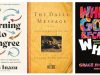
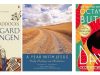
Here are some excellent new theology books * that will be released in July 2022 :
* broadly interpreted, including ethics, church history, biblical studies, and other areas that intersect with theology
See a book here that you’d like to review for us?
Contact us, and we’ll talk about the possibility of a review.
  |
1–2 Peter and Jude (Volume 56 – Wisdom Commentary Series)Pheme Perkins, Eloise Rosenblatt, Patricia McDonald(Liturgical Press) Reading 1 Peter through the lens of feminist and diaspora studies keeps front and center the bodily, psychological, and social suffering experienced by those without stable support of family or homeland, whether they were economic migrants or descendants of those enslaved by Roman armies. In the new “household” of God, believers are encouraged to exhibit a moral superiority to the society that engulfs them. But adoption of “elite” values cannot erase the undertones of randomized verbal abuse, general scorn, and physical violence that women, immigrants, slaves, and freedmen faced as the “facts of life.” First Peter offers the “honor” of identifying with the Crucified, “by his bruises you are healed” (2:24). A Christian liberation ethic would challenge 1 Peter’s approach. Pliny the Younger, governor of Bithynia-Pontus in north-western Asia Minor, is a contemporary of 2 Peter’s writer. The polemical, accusatory genre of 2 Peter, like Jude, originates in Roman judicial rhetoric. The pastor, in the persona of a prosecuting attorney, condemns immoral defendants, including influential women. Their “crimes” encode community tensions over women’s leadership, Gentile-members’ sexual ethics, their syncretistic deviations from Jewish doctrine on creation, and the certainty of divine judgment and punishment. Citations to Elizabeth Cady Stanton’s A Woman’s Bible enliven the commentary. The doctrinal disorder prompts the male pastor to sustain loyalists in their commitment to “Our Lord and Savior Jesus Christ.” Second Peter dramatizes an ecclesial crisis whose “solution” was the eventual imposition of a magisterium to silence dissent. Brief, combative, and assuming a familiarity with a literary culture that most twenty-first-century readers do not have, the Letter of Jude would be an obvious candidate for being the most neglected book of the New Testament. As a model for a pastoral strategy, it can be recommended only with great reservations: almost everyone will find in it something problematic, if not offensive. Yet, in addition to giving a window on a Greek-speaking Jewish-Christian milieu, Jude’s energetic prose testifies to the author’s visceral concern for those attempting to live by the gospel in difficult circumstances. Furthermore, to the extent that over familiarity with parts of the New Testament can blunt their challenge, this letter provides a salutary reminder that the entire canon originated in a world that is radically unfamiliar to us. ADVERTISEMENT:    Eastern Orthodoxy and the Science-Theology DialogueChristopher C. Knight(Cambridge UP) This Element examines the science-theology dialogue from the perspective of Eastern Orthodox Christianity and provides a critique of this dialogue based on six fundamental aspects of that theology: (i) Its understanding of how philosophy may authentically be used in the theological task; (ii) Its understanding of the use and limitations of scientific and theological languages; (iii) Its understanding of the role of humanity in bringing God’s purposes to fulfilment; (iv) its sense that material entities should be understood less in materialist terms than in relation to the mind of God; (v) Its Christological focus in understanding the concept of creation; (vi) Its sense that the empirical world can be understood theologically only when the ‘world to come’ is taken fully into account. It is argued that Orthodoxy either provides an alternative pan-Christian vision to the currently predominant one or, at the very least, provides important new conceptual insights. |
*** Which of these theology books of July 2022 do you want to read first?
<<<<< PREV. PAGE |
|
ADVERTISEMENT:

C. Christopher Smith is the founding editor of The Englewood Review of Books. He is also author of a number of books, including most recently How the Body of Christ Talks: Recovering the Practice of Conversation in the Church (Brazos Press, 2019). Connect with him online at: C-Christopher-Smith.com
 Reading for the Common Good From ERB Editor Christopher Smith "This book will inspire, motivate and challenge anyone who cares a whit about the written word, the world of ideas, the shape of our communities and the life of the church." -Karen Swallow Prior Enter your email below to sign up for our weekly newsletter & download your FREE copy of this ebook! |
 Understanding Christian Nationalism [A Reading Guide]
 |
 Most Anticipated Books of the Fall for Christian Readers! Most Anticipated Books of the Fall for Christian Readers!
|
 Hilarious One-Star Customer Reviews of Bibles Hilarious One-Star Customer Reviews of Bibles |