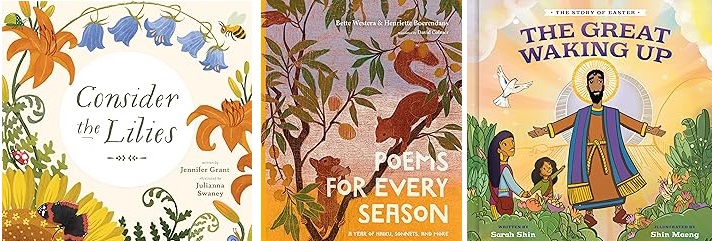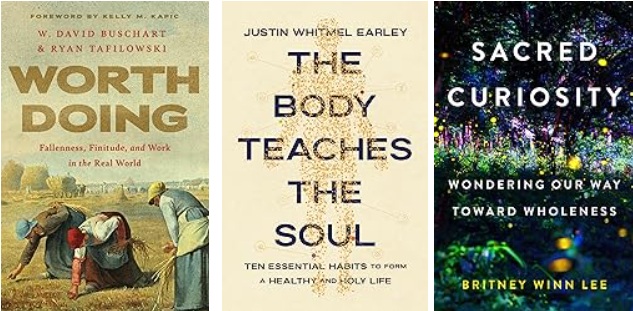
The first half of 2026 promises a ton of excellent new books! Here are 60+ of our most anticipated books of Spring 2026 for Christian Readers…
These anticipated books of Spring 2026 (released in the first half of the year) wrestle with some of the deepest challenges of our day, and will orient us toward faithful living in the present and in years to come.
Want this list as a printable PDF?
Sign up for our newsletter now
and we’ll send it to your inbox.
[ TOP 10 – Part 1 ] [ Top 10 – Part 2 ]
[ Theology ] [ Church / Formation ] [ Literature ]
[ NonFiction ] [ History / Biography ]
[ Young Readers ] [ Coming in Fall 2026! ]
Page 2: TOP 10 – Part 2
(In Alphabetical Order by Author’s Last Name)

Becoming Neighbors: The Common Good Made Local
by Amar D. Peterman
(Eerdmans, March 12)
The work of cultivating the common good starts in your own neighborhood.
In Becoming Neighbors, Amar D. Peterman explores how the common good can be cultivated through the practice of neighbor love. And he encourages Christians to join their neighbors at what he calls “the shared table”―a space where communities gather across differences to work towards the flourishing of the whole.
Within every neighborhood, people have daily opportunities to show up for each other and share the best of their traditions, cultures, and beliefs. But too often, Christians keep to themselves―and when they do show up, many spend more time talking than listening. Peterman encourages Christians to adopt a different posture: to sit side by side with their neighbors at the community table, share a meal, engage in mutual listening and learning, and actively commit to each other’s flourishing.
Peterman illuminates the faith-based insights that Christians can bring to the table, such as the biblical call to love others, to seek goodness, and to build communities of belonging. And he offers tangible practices of neighbor love―including compassion, resonance, lamentation, and accompaniment―that translate across diverse populations. Peterman also demonstrates how Christ’s example as prophet, priest, and king serves as a guide for how Christians might live faithfully in their communities today.
At the heart of this book is a simple but critical question: How will we live? Amid our differences and disagreements, through the strife and terror of our world, through the reality of death and the hope of resurrection, the answer for Christians is clear: We live as neighbors.

Make Your Home in This Luminous Dark: Mysticism, Art, and the Path of Unknowing
by James K. A. Smith
(Yale UP, March 24)
A philosopher journeys back to the mystics to learn how to live with uncertainty in the twenty-first century.
How do we live when we don’t know what to believe, or who to believe, or how we could even know? In this deeply felt book, philosopher James K. A. Smith explores how radical uncertainty can be liberating, opening us to another way of being. The pain of his own profound uncertainty led Smith to a surprising source for modern consolation: the mystical experiences of St. Teresa of Ávila, St. John of the Cross, and the author of The Cloud of Unknowing. These mystics testify to a deeper truth beneath distraction, anxiety, and fear: love.
Drawing on ancient traditions of contemplation as well as on contemporary novels, poetry, film, and paintings, Smith speaks to the fundamental yearnings that persist in late modernity, including the philosophical quest for knowledge and certainty. He shows us how the gifts of the Christian contemplative tradition and the riches of creative works embody a liberating spirituality that recovers the fullness of being human.
In bringing a philosopher’s questions to the mystics, Smith brings a mystical heart back to philosophy.

Watch and Wonder: Birding as a Spiritual Practice
by Ragan Sutterfield
(Broadleaf Books, March 17)
Birding can nourish our spiritual lives.
Birdwatching is a delight, a deepening. It puts us in touch with the ineffable, and it draws us toward self-denial for the sake of love. Birding brings us close to hope, abundance, and joy. In fact, it looks a lot like prayer.
From having his vision opened by a rare flycatcher, to learning the power of naming while watching shorebirds, to forging friendships on a Christmas Bird Count, naturalist, birder, and Episcopal priest Ragan Sutterfield delves into how birdwatching shapes our souls. He writes of turning yards into refuges for birds on their long migration. Even as we reckon with the inconsolable grief of habitat loss and species decline, he writes, birds can give us hope amid the desolation.
Readers of Margaret Renkl, Drew Lanham, and Terry Tempest Williams will find a kindred spirit in Sutterfield as he explores, in verdant and lyrical prose, the spirituality of birding over a year of watching, waiting, and wondering. In each chapter, Sutterfield names a particular way in which paying attention to birds shapes our souls and draws us toward awe. Twelve virtues and practices rooted in the Christian tradition–including joy, attention, slowness, kenosis, and friendship–are nurtured within us as we wait and watch and wait some more. Watching birds, we move toward sacramental sight: looking at the visible to find the holy hidden behind it.
Winged wonders that delight and sometimes disappoint, birds are ever within and beyond our vision. Whether you are a serious birder with an extensive life list or a casual observer of hawks along the highway, this book is an invitation to wonder and awe. It only takes paying attention.
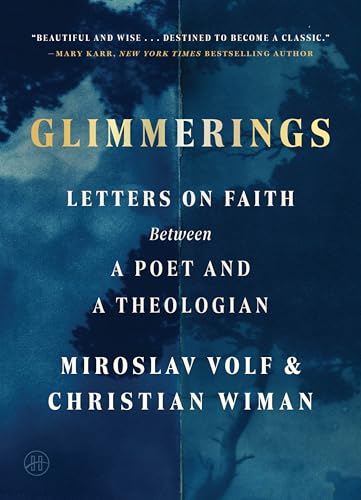
Glimmerings: Letters on Faith Between a Poet and a Theologian
by Miroslav Volf and Christian Wiman
(HarperOne, January 13)
From award-winning authors and Yale Divinity School colleagues Christian Wiman and Miroslav Volf—two world-renowned scholars exchange letters on the problems of faith today and the presence of divine love that persists through it all.
Whether you’re seeking something to believe in or no longer feel at home in your traditions, the spiritual search can be deeply lonely.
In Glimmerings, leading Christian theologian Miroslav Volf and celebrated poet Christian Wiman engage the tensions of belief felt by many. In an exchange of personal letters, Volf and Wiman give voice to and validate the most pressing spiritual questions of our time. Close friends and Yale colleagues, they reveal through their letters visions of faith that are sometimes sharply divergent, yet always honest and punctuated by warmth, humor, and apology. The result is a vivid, consoling collection in which questions are dignified and the spiritual search in all its complexities is honored.
Whether they’re discussing Scripture’s most problematic texts, Christianity’s most preposterous claims, or their own experiences of God’s presence and absence, Volf and Wiman are united in their shared refusal to oversimplify the realities of human pain. Instead, we are invited to share an honest hope: While certainty can never be ours, perhaps God shows up in “glimmerings.” As we accompany each other in our tensions, we can find strength in solidarity, beauty in mystery, and love that persists even as our faith perplexes.

What Grows in Weary Lands: On Christian Resilience
by Tish Harrison Warren
(Convergent Books, May 12)
How do we cultivate faith that endures? From award-winning author and former New York Times writer Tish Harrison Warren comes a fresh vision for navigating burnout and weariness through ancient Christian practices—guiding us toward lives of resilience, renewal, and flourishing.
Early Christians often grappled with a reality we rarely talk about in contemporary life: that God seems to abandon the soul at times, leaving us feeling as if we are alone and left to our own resources. These are times of futility, when work and relationships feel hard, when prayer feels unsatisfying, and we question whether our efforts are amounting to anything.
For centuries, Warren notes, times of “aridity” were seen as necessary prerequisites for growth and maturity. Yet in our culture fixated on speed and optimization, we risk losing this deeper sense of the human journey and the resilience that comes with it.
Writing for a moment when two-thirds of Americans are dissatisfied with their work, and a sense of languishing is widespread, Warren draws from both her own season of exhaustion and the rich well of Christian tradition—particularly that of the earliest Christian monks—to discover the habits and mindsets that anchor us in times of doubt, difficulty, and spiritual dryness. She offers hope to those who feel like life is overwhelming, taxing, and disorienting.
What Grows in Weary Lands speaks to anyone longing for a life of depth in a distracted age. Warren helps us see that nothing is wasted—that even in desert seasons something good is growing, rooted in grace and reaching toward glory.
Want to buy some of these books?
Shop from our lists
on BOOKSHOP or AMAZON
<<<<< PREV. PAGE |
NEXT PAGE >>>>>
ADVERTISEMENT:
 Reading for the Common Good From ERB Editor Christopher Smith "This book will inspire, motivate and challenge anyone who cares a whit about the written word, the world of ideas, the shape of our communities and the life of the church." -Karen Swallow Prior Enter your email below to sign up for our weekly newsletter & download your FREE copy of this ebook! |
 Understanding Christian Nationalism [A Reading Guide]
 |
 Most Anticipated Books of the Fall for Christian Readers! Most Anticipated Books of the Fall for Christian Readers!
|
 Hilarious One-Star Customer Reviews of Bibles Hilarious One-Star Customer Reviews of Bibles |