

 Swirls in Ink.
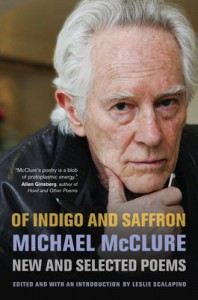
A review of
Of Indigo and Saffron:
New and Selected Poems.
Michael McClure.
Buy now: [ Amazon ] [ Kindle ]
Reviewed By J. Ted Voigt
So maybe you’re not a beatnik. Maybe, like me, you were born about three decades too late for the Beat Generation. Fortunately for us, Michael McClure was born in 1932, making him just shy of 23 years old when he read with Allen Ginsberg and others at the Six Gallery reading in San Francisco, in a sense, kicking off what is now known as the Beat Generation. The poems McClure read on that night are collected in his newest book, Of Indigo and Saffron, along with many (many) others, comprising a mostly chronological survey of a career spanning over five decades of drugs, travel, peace and poetry.
My first recommendation when opening Of Indigo and Saffron is to skip the introduction. This is usually bad advice, but in this case, you will thank me. Instead, if you’re curious, get some background information on the web. The introduction, though it provides a few sparse details about McClure and his career, is almost as inaccessible as some of McClure’s early poetry. It is written by Leslie Scalapino, author of such works as Day Ocean State of Stars’ Night and Floats Horse-Floats or Horse Flows, and her introduction to this book is experimental, to say the least.
In fact, I would recommend you go directly to page 23 where the book begins with McClure’s earliest work. After reading several of his early poems, especially “Peyote Poem,” you may want to go back and read the introduction. Trust me. Just go to wikipedia.
Michael McClure has been reading his poetry out loud for over 50 years, and he’s probably best enjoyed in that form. With the release of this book, the University of California Press has also released some video footage of McClure, including a clip of him reading to the lions at the San Francisco Zoo in 1966. Reading the poem entitled “49” in Of Indigo and Saffron (83) is really not the same as hearing it read, especially since half of this particular poem is written only in lion-noises. The video is on YouTube, it’s called “Michael McClure reading poetry to lions” and it is well worth a visit if you are new to McClure’s work.
Through all the hallucinogens and growling, McClure’s real identity eventually becomes clear in his poems. A long time Buddhist, much of his work reflects a kind of compassionate non-violent ethos that would still be very popular today, if people still read beat poetry. In “Point Lobos: Animism,”(29) one of his original poems from the Six Gallery readings, he writes “It is possible that the absence of pain/ May be so great/ That the possibility of care/ May be impossible.” There is today a growing dissatisfaction with the soul numbing life of suburban America, and McClure directly addresses that numbness from his very first publication Hymns to St. Geryon in 1959. His work screams for us to live in the moment, which is cliché now but I suspect it was not so when he started talking about “the moment” back in the sixties. His work reminds us that we exist only in the present, like a gondola car on the cable of time. The past no longer exists, and we should not feel guilt from it; neither does the future yet exist, and so it can be changed. “NOW IS THE TIME FOR ACTION” (102) He writes in the 10 page poem “Poisoned Wheat,” the most overtly political but also one of the most coherent poems in the collection.
Click on the link below to continue reading on Page 2…
 Reading for the Common Good From ERB Editor Christopher Smith "This book will inspire, motivate and challenge anyone who cares a whit about the written word, the world of ideas, the shape of our communities and the life of the church." -Karen Swallow Prior Enter your email below to sign up for our weekly newsletter & download your FREE copy of this ebook! |
 Understanding Christian Nationalism [A Reading Guide]
 |
 Most Anticipated Books of the Fall for Christian Readers! Most Anticipated Books of the Fall for Christian Readers!
|
 Hilarious One-Star Customer Reviews of Bibles Hilarious One-Star Customer Reviews of Bibles |







I would say that most poetry is best when heard read aloud. There is something to the intonational cadence of the human voice that amplifies punctuation.