Holding Onto the Historical Jesus and the Gospel
A Review of
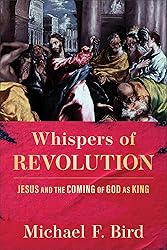
Whispers of Revolution: Jesus and the Coming of God as King
Michael F. Bird
Baker Academic, 2025
Buy Now: [ BookShop ] [ Amazon ] [ Kindle ]
Reviewed by Leonard J. Vander Zee
Whispers of Revolution is a book that looks at Jesus from a purely historical perspective. Michael Bird, an Australian scholar, writes in the Preface, “Some of my friends, such as Scot McKnight, have abandoned the historical Jesus project, instead preferring…the Jesus of the canonical Gospels.” Even the publisher is a bit coy about the word history, which appears nowhere in the title.
We can understand why. The “Historical Jesus” movement and the Jesus Seminar, which sought to discover the real historical Jesus rather than the Jesus of faith, seems to have lost steam among scholars. It became a contest to see what was left of Jesus after he was scrutinized under the secular, skeptical lens of historical study. In this scenario, the canonical Gospels, with their miracles and resurrections, are not to be trusted, leading to the conclusion that not much Gospel is left.
But Michael Bird is convinced we cannot just abandon this historical study to sceptics. “The Jesus Seminar offered a portrait of Jesus as a person more Hellenistic than Jewish in ethos, someone opposed to Jewish purity scruples, committed to a kingdom of socio-economic equals, and against imperialism and patriarchy, whose beliefs were conveniently shorn of Jewish apocalyptic hopes and who dropped counter-cultural aphorisms like a beatnik poet slamming ‘the man.’ It all added up to someone looking more like the ‘California Jesus’ than the historical Jesus.”
Bird believes that looking at Jesus from a historical perspective is still important. It is necessary as a “prolegomenon” to both biblical studies and theology. As he puts it, “there is a real history to be found and real insights can be made” through rigorous historical study. He admits reading things from the Jesus Seminar that ring true, and that he’s had to “change my mind about certain things pertaining to Jesus, when confronted with overwhelming evidence, even when it had certain ‘flow on’ effects in my own religious devotion.”
Of course, the gospels are not only historical documents; they are proclamations of Jesus and the Kingdom of God. Yet these proclamations are embedded in a historical time and place. Bird proposes an “epistemology of critical realism (history is knowable, but never independently of the knower), a type of believing criticism for the religious reader (Christian faith requires the historical study of Jesus), and a genuine commitment to the truth (the necessary condition for an open and honest enquiry into any topic).” This historical study of Jesus furthers Biblical studies by examining time and place and furthers theology and Christology by anchoring the incarnate Son of God in his first-century home.
Bird conducts his research of the Jesus story chronologically and thematically. He undertakes this not as a “Bible Study;” he does not advocate for the values of the Kingdom of God or sort through the various ways of understanding the atonement. Instead, he takes seriously the disagreements between the Gospels as to persons, times, and incidents that they describe.
In the section on Jesus’s teaching, Bird recognizes that church teaching has often skewed what Jesus said about the Torah. Then he summarizes what he thinks are the best conclusions based on the Torah’s Second Temple setting and Jesuss’ own words about it. He also wrestles with Jesus’s apocalyptic warnings and whether they were all focused on historical events or on some distant apocalyptic event. He concludes that Jesus warned of both the nearer events of the Temple’s destruction and the final Day of the Lord.
The section “Jesus and his Contemporaries” surveys the primary actors among the Jews of Jesus’s day, the Pharisees, Sadducees, Zealots, Essenes, priests, and others. We get a picture of the deep divisions within Palestinian Judaism of the time, divisions that are not so different from our own, and we see how Jesus related to these groups and how they understood him and his message. Bird also discusses what we can know about Jesus’s own family, his brothers and sisters, a subject that’s often neglected.
In the section on Jesus’s last days in Jerusalem, a long passage on his “Triumphal Entry” brings together how the expectations of Passover week were boiling over in the tumult of thousands of pilgrims. Did Jesus tamp it all down, or did he bring it to a head? Bird’s conclusions will affect how I view and celebrate Palm Sunday in the future. Strikingly, Bird spends less time with the actual moment of Jesus’s crucifixion than with Jesus’s Triumphal Entry, focusing on the manner of the crucifixion and its meaning in the Roman world. Why? Because historical study of the Gospels does not focus on the theology of atonement. Rather, we get the horror of the moment and its effects on the populace.
This book helped me understand many things: the importance of the historical study of Jesus and the Gospels and how much the history of the Gospels impacts the preaching and teaching in our churches. I saw that if we don’t understand the place of the Torah in Jewish life and in Jesus’s teaching, we might lean too hard on the law and gospel language of Paul. I realized how Jesus’s interactions with the factions in Jerusalem affects how we preach about his relationship with the Scribes and Pharisees. Our faith is not just a belief in salvation through Jesus Christ. “I believe he was crucified under Pontius Pilate” means our faith is anchored in historical events.
The real test of an historical study of the Jesus of the gospels is the resurrection. Here Bird keeps the historical perspective. No matter how much we want to count the faith of the disciples and the women at the tomb as historical evidence, Bird acknowledges that it is not. “History does not deal in miracles,” says Bird, “Jesus lived and died—that much we know; but whether Jesus lived and died and lived again, that is always going to haunt historians, sceptics, believers, and agnostics. Perhaps that is why the best-attested ending of Mark’s Gospel is so abrupt, finishing at 16:8. We have to decide.”
In addition to its solid historical work that deepens our grasp of the Gospels, this book is fun to read. Occasionally, as though he couldn’t help himself, Bird lets loose with a quip. On the Triumphal Entry, he says, “The modern equivalent would be some zealous Christian kicking in the windows of the giftshop at St. Paul’s Cathedral in Melbourne because the vergers and shop assistants had turned the cathedral into a ‘den of thieves’ by selling cringy kitsch religious merchandise.”
I also want to commend the publisher for a book that is lovely to handle. The pages have a nice sheen, and the print is readable. Footnotes are on the bottom of the page, which I like, and there is a bibliography and a Bible index at the end. The index makes this book a great tool for preachers as a part of their research for a sermon on a Gospel text.

Leonard Vander Zee
Leonard Vander Zee is a retired pastor in the Christian Reformed Church, married to Jeanne Logan, and father of four and grandfather of 12. Besides serving as occasional Interim Pastor he loves playing tennis, pickleball, and golf, and reading the theology of the church fathers. He is author of Christ, Baptism, and the Lord's Supper (IVP, 2004).
 Reading for the Common Good From ERB Editor Christopher Smith "This book will inspire, motivate and challenge anyone who cares a whit about the written word, the world of ideas, the shape of our communities and the life of the church." -Karen Swallow Prior Enter your email below to sign up for our weekly newsletter & download your FREE copy of this ebook! |
 Understanding Christian Nationalism [A Reading Guide]
 |
 Most Anticipated Books of the Fall for Christian Readers! Most Anticipated Books of the Fall for Christian Readers!
|
 Hilarious One-Star Customer Reviews of Bibles Hilarious One-Star Customer Reviews of Bibles |