Healing Through Story and Cinema
Our Interview with
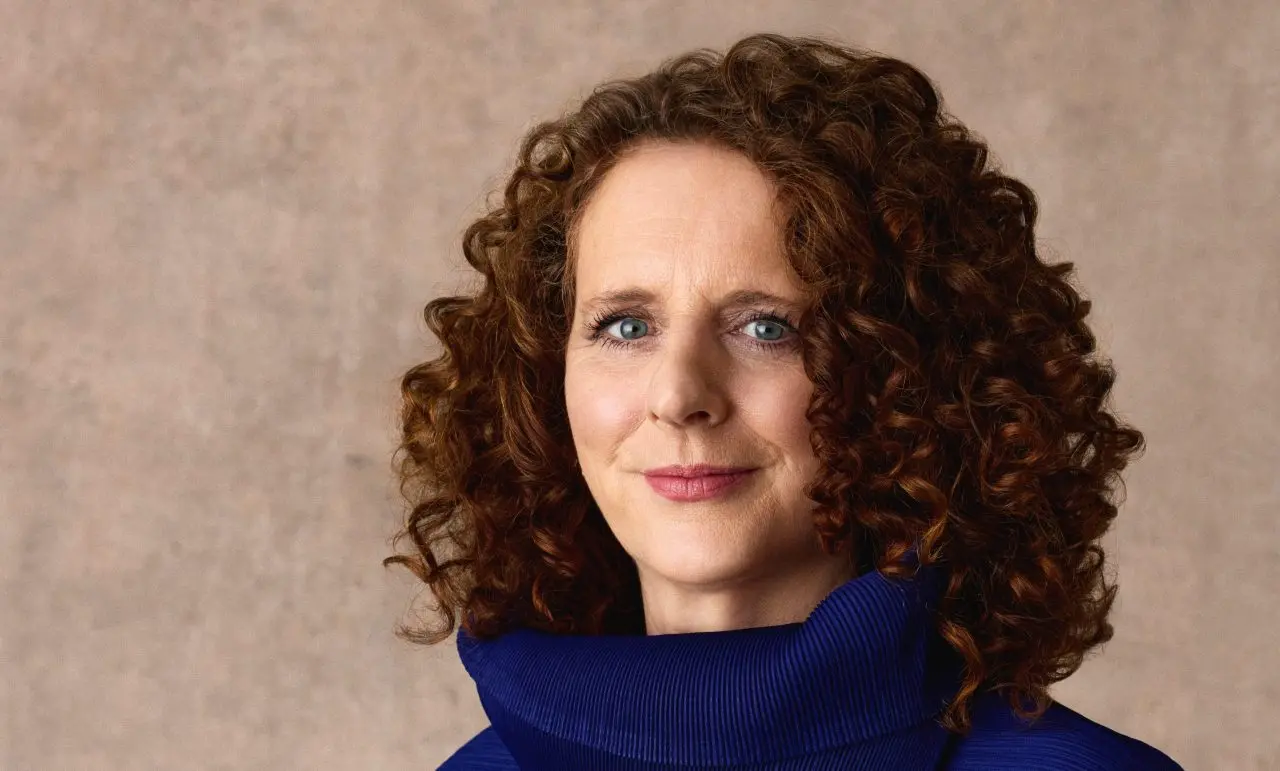
Maggie O’Farrell,
the Bestselling Author of Hamnet
by Lindsey Cornett
 Hamnet:
A Novel of the Plague
Maggie O’Farrell

Paperback: Knopf, 2021
Buy Now: [ BookShop ] [ Amazon ] [ Kindle ] [ Audible ]
In 1559, the bubonic plague was spreading through Europe, and William Shakespeare and Anne Hathaway Shakespeare buried their eleven year-old son, Hamnet.
In March 2020, COVID-19 was spreading through the world, and Maggie O’Farrell released a book inspired by that fourteenth century death of Shakespeare’s son.
O’Farrell’s Hamnet: A Novel of the Plague went on to be named one of The New York Times’ best books of 2020 and was later named to the NYT’s list of reader’s favorite books of the early 21st century. Today, it’s also a feature film, directed by Chloé Zhao. Zhao co-wrote the screenplay with O’Farrell.
On the night before I sat down to chat with Maggie O’Farrell, that film adaptation of Hamnet was nominated for eight Academy Awards, including Best Picture, Best Director, Best Actress, and Best Adapted Screenplay.
In this interview, we chat about the meaning imbued in her novel, the challenge of adapting it to the screen, and the value of Shakespeare in the lives of readers.
The interview has been edited for clarity and length.
ERB: I know that Hamnet is inspired not so much by Hamlet, the play, as much as this piece of Shakespeare’s biography, but I wanted to begin by asking you what your earliest memory of encountering Shakespeare and his work is, whether Hamlet specifically or Shakespeare more generally. What has his work meant to you, and when did you first encounter it in a meaningful way?
MO: Well, I grew up in a time when Shakespeare was very much part of the school curriculum, which I think is much less the case these days, sadly. I attended a very ordinary state school, and we did a Shakespeare play every single year from the age of eleven. We started off with Romeo and Juliet, and you knew that next year you go on to Hamlet, and then you do MacBeth and then Julius Caesar. I found it incredibly exciting. You felt when you did your first Shakespeare play like it was a real benchmark that you’d reached. It was hard but exciting. You felt a kind of maturity settling upon you, because you thought, “I’m old enough. I have been deemed old enough to grapple with this language and this situation.” That was really exciting, and I loved it. I particularly loved Julius Caesar. We had to learn Julius Caesar’s speeches off by heart, and weirdly I can still remember them. There’s something about learning things at that age that allows it to lodge in your brain.
We did Hamlet when I was sixteen, and I really fell in love with Hamlet in a way that was even deeper than the other Shakespearean plays I’d read. I think it appeals to a certain type of teenager, one who wears a lot of black and much too much eyeliner and hangs about in graveyards taking black and white photographs. I was definitely that kind of teenager. The character of Hamlet felt as though he kind of shared my DNA, you know? He felt like a brother or something to me.
I had a really good literature teacher in high school, and he mentioned in passing one day that Shakespeare had a son who’d been called Hamnet, and that he had died four or five years or so before Shakespeare went on to write Hamlet. The similarity of the name really struck me, and I thought, “What does it mean?” It could not have been a casual decision; nobody would casually give their dead son’s name to a prince and a ghost in a play they were writing.
ERB: Let’s talk more about the significance of names in the story. There’s the obvious one: Hamnet vs. Hamlet. You also made a significant choice to call Shakespeare’s wife “Agnes” rather than Anne. Importantly, in the book, William Shakespeare is never named. He is referred to as the father, the tutor, the husband, but never by name. (No spoilers as to whether that is maintained in the movie version.) How are you thinking about the significance of the characters’ names as you’re writing, and what do the names reveal about the story you’re trying to tell?
MO: Yes, I do think the novel is very concerned with, as you say, with names. It begins with the idea of the very very close similarity between Hamnet and Hamlet. Actually, when Shakespeare wrote Hamlet, it was drawn from an earlier play called Amleth, but he obviously changed the name to mirror his son’s. And as you said, in the novel I don’t name Shakespeare. The name Shakespeare never appears in any form–not “William Shakespeare” or “Will Shakespeare” or any of that. In order to write fiction about Shakespeare, I had to completely get rid of that name. I found I couldn’t write a sentence like, “William Shakespeare walked up the path and knocked on the door…”
ERB: You needed a little distance, maybe?
MO: Yeah. It was discombobulating. I thought, “Well, if I can’t stay submerged in the narrative, I can’t expect my readers to.” So I decided to do away with that name entirely. In a sense, he’s become divorced from his own name. The word Shakespeare is an adjective that we bandy about all the time, and it refers to anything from clothing to a period in history to a style of speech to a style of drama. It’s not much connected to him anymore, as a human being. I wanted to ask readers to forget everything they think they know about William Shakespeare the literary being and just meet an actual human being–a person.
And Agnes. History always calls her Anne Hathaway, which is strange because for most of her life, her name was Shakespeare. Her father’s will was one of the documents I read in preparation for writing. He died a year before she married William. In the will he leaves her a very generous dowry, and he also refers to her as, “my daughter, Agnes.” That was a real lightning bolt moment for me. On top of everything else about the way scholarship and biography has treated her, we’ve been calling her by the wrong name for all these years. I thought, “If anyone knows her real name, surely it’s going to be her father.” I wanted to give that name back to her.
ERB: I imagine there’s an alternate universe, maybe, in which this book could be called Agnes instead of Hamnet, right? So much of the narrative really centers around Agnes, her work in the world, her as a mother, and her relationship with her husband. I really I appreciated that you gave her her name. In the same way we don’t really understand William Shakespeare as a real human as much as an entity, his wife has become a side character or a footnote. You’ve returned her story to her.
One of the things we’re always trying to encourage people to do here is to read more deeply, to sit with a work a bit longer. I’m wondering if coming back to Hamnet another time– now in collaboration with Chloé Zhao, the director of the film–changed your experience of the story. Obviously, there are different things you can convey with a visual medium, but I’m curious about your understanding or engagement with the story yourself, as a writer. Did that change or deepen in any way by adapting the book?
MO: I think I learned a lot about storytelling and about narrative, more than about the subject of the story or its themes. I think I had mined them pretty deeply while writing the novel. So, writing the screenplay was more about how to disassemble and reassemble a narrative for the screen, and also about the language of cinema. I love the cinema, and I’ve always always gone to the cinema as often as I can, but I’d never thought really carefully about the adaptation from page to screen. A reader sitting in a chair with the novel will be interacting with the narrative very differently than people sitting in a cinema watching it on screen. You have to rebalance the story, in a sense, in order to make it work on the screen. You have to rebalance the narrative to make sure that your cinema audience can make the same connections and develop the same empathy that was created on the page.
I learned an awful lot. It was not only about the economy of cinematic language, but also about trusting your collaborators, which was really interesting. As a lone wolf novelist, I can add so much nuance and detail into a chapter or a page or a paragraph, but it has to be taken out for the screenplay. What I realized sitting on set watching a take is that I needed to trust all the people involved–the actors and the director and the cinematographer and the costume people. They added back all the detail and nuance.
ERB: One of the major themes of Hamnet is the power of art and storytelling to bring healing to our lives and to help us process grief, loss, and death. It is so interesting that this novel was published in March of 2020, and the subtitle is “A Novel of the Plague.” It feels strangely prophetic, almost.
MO: I wish I could claim that I had foreseen the COVID pandemic, but I did not. It was a very strange coincidence. I do remember when I was writing the book in 2018, I was planning the chapter which traces the journey of the plague all the way to England. I remember sitting in the same chair I’m sitting in now and thinking, “I wonder what it’s like to be living in a world where this deadly illness is coming towards you, getting ever closer.” What must it have been like? I had to try and imagine myself into that situation before I could write that chapter.
Later, we were watching COVID get closer and closer, and by the time it reached Italy, it was around February 2020. We knew it was only a matter of time when it would come here to the UK. I was looking at the maps of the plague I used to write that chapter, and the infographics I was looking at on the news looked almost exactly the same. It was very strange.
ERB: I sometimes wonder if the really difficult place we find ourselves in right now in America (and perhaps globally as well) is due in part to the lack of real grieving, processing, and healing in the aftermath of the COVID pandemic. We failed to process collectively in a meaningful way. In your imagining of this story, Hamlet is key to William’s healing and processing the loss of his son, and perhaps in reconciling with Agnes, though you don’t tie that bow up neatly in the novel. I wonder if you have any thoughts about the role that art, storytelling, and creativity might play in our current moment. Can they help to bring healing or reconciliation to us now?
MO: I think everybody grieves very, very differently and at a different pace. If you lose someone, even individuals in the same family are going to approach that very differently. But I think it’s no coincidence that every funeral you go to, there’s always somebody reading a poem or there is music. We need it. Art explains us to ourselves, you know, and it offers us a road map through life and through difficult situations. It’s always going to be a part of who we are. Even the very earliest humans–before we were even homo sapiens–were painting on cave walls. Art is just a very human response.
ERB: Have there been art or books that have played that role for you, helping you to process or grieve or heal?
MO: I don’t know how much time we have really to cover that! I think of so many things. I think all art changes us, and we don’t always know really until we’re through it, do we? One of the books I read and reread, actually, throughout the COVID pandemic is The Old Filth Trilogy by Jane Gardam, who died last year, in fact. It’s an amazing trilogy about three people whose lives span the 20th century with all its enormous ups and downs. That was an incredibly stimulating and comforting read for me throughout that whole strange pandemic period. I would recommend that, because I think those novels are real testaments to human resilience.
ERB: We have a practice of ending every author interview by asking what you are reading right now. Is there anything interesting that you’re currently reading?
MO: I am reading Helen Garner’s diaries, and they’re amazing. I have them by my bed, and they’re huge thick volumes you can kind of dip in and out of. She is a very brilliant Australian novelist, and she’s published her diaries from the 1970s and 80s. They’re just little tiny vignettes and observations from her days. At one point, she says that she’s writing the best things and the worst things in her diary. She writes so beautifully. Her novels are beautiful, but her diaries are fascinating and very, very moving.

Lindsey Cornett
Lindsey Cornett is a loud talker, obsessive coffee drinker, and lover of the written word who lives in downtown Indianapolis with her scientist husband, 3 kids, and crazy Bernedoodle. Most days, you’ll find her wrangling the dog, managing snacks, reheating her coffee, and trying to savor as much joy and gratitude as she can in the middle of these very full days. Lindsey writes a monthly-ish email newsletter about the intersections of faith, community, and curiosity at lindseycornett.substack.com.
 Reading for the Common Good From ERB Editor Christopher Smith "This book will inspire, motivate and challenge anyone who cares a whit about the written word, the world of ideas, the shape of our communities and the life of the church." -Karen Swallow Prior Enter your email below to sign up for our weekly newsletter & download your FREE copy of this ebook! |
 Understanding Christian Nationalism [A Reading Guide]
 |
 Most Anticipated Books of the Fall for Christian Readers! Most Anticipated Books of the Fall for Christian Readers!
|
 Hilarious One-Star Customer Reviews of Bibles Hilarious One-Star Customer Reviews of Bibles |