 Who is Fit for the Secular Kingdom?
A Review of
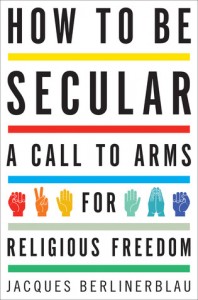
How to be Secular: A Call to Arms for Religious Freedom
Jacques Berlinerblau
Hardback: HMH Books, 2012.
Buy now: [ Amazon ] [ Kindle ]
Reviewed by Matthew J. Kaul
When I was a child, I talked like a child, I thought like a child, I reasoned like a child. I listened to a lot of Christian rock. One of my favorite bands was Audio Adrenaline. Audio A’s second album, and the one that introduced me to them, was called Don’t Censor Me. Listening to it now is a bewildering experience.
The album’s theme — remember, this is rock music — is a defense of what many would call “traditional values.” It’s full of rock-n-roll protest songs that call for a defense of the Christian family-values establishment. And no small amount of the Christian rock that I listened to (which is to say, the most popular Christian rock) took this form: in addition to several tracks on Don’t Censor Me, songs by the Newsboys and dc talk expressed similar sentiments.
What concepts help us understand such strange juxtapositions as rock and conservative politics? What’s the best way to understand what it means to headbang to lyrics like “You can take God out of my school / you can make me listen to you. / You can take God out of the pledge / but you can’t take God out of my head”? Who was I, as I was doing so?
In Jacques Berlinerblau’s terms, I would be a good little “revivalist.” What’s a revivalist? It’s tough to say, because he never defines the category. He’s not using it in the tradition sense of someone who works for or participates in a revival meeting. For Berlinerblau, the “Revival” (both terms are always capitalized, because they’re really scary) is simply the fact that religion hasn’t died off yet:
“For decades social scientists have been tracking the global resurgence of religion much in the way that scientists monitor a tornado from a chase van. Years ago sociologists such as Daniel Bell and Robert Wuthnow described this trend as the ‘return of the sacred,’ or the ‘rediscovery of the sacred.’ A little while back another sociologist, Peter Berger, noted that ‘conservative or orthodox or traditionalist movements . . . are on the rise almost everywhere” (xix).
This “resurgence” of religion (whether it ever waned is another question entirely) is the Revival. Berlinerblau chiefly uses the term in opposition to secularism, which he actually does define, in conventional terms, as a political philosophy that is suspicious of any relationship between government and religion.
But is it fair to lump together such seemingly diverse phenomena as the “rediscovery of the sacred,” which seems to suggest a fairly innocuous, generic spirituality, with “conservative or orthodox or traditionalist movements”? Probably not. So it’s clearly asking way too much to suggest that even the phrase “conservative or orthodox or traditionalist movements” itself requires much greater conceptual precision and rigorous definition to be useful.
Sadly, with such sweeping generalizations at the book’s foundation, How to be Secular isn’t a very useful guide at all to how a person might be secular. It’s clear that Berlinerblau dreads the prospect of Revivalists, through lawful, democratic means, somehow creating some sort of theocratic state. But his examples come off as little more than scare-mongering:
“The religious Right has spent decades plotting how to . . . recapture the judicial branch. They may be well on their way to accomplishing this as they flood the offices of the federal government with conservative Christian lawyers. It is no coincidence that the law school at Jerry Falwell’s Liberty College [sic] contains an exact 4,395-square-foot replica of the US Supreme Court” (107). His proof of a Revivalist uprising is the mediocre law school of an irrelevant evangelist? Forgive me for not sharing his fear.
But, lest I be accused of helping foment the Revivalist insurgency (trust me, no one was more pleased to see the crushing defeats of Tea Party candidates Todd Akin and Richard Mourdock than I was), allow me to restate the challenge as Berlinerblau sees it.
For him, the problem of secularism’s waning is one of public relations: the New Atheists and their ilk have done a poor job presenting secularism as something that’s worth striving for and defending. Berlinerblau goes to great lengths to disavow the New Atheists and to deny that they speak for American secularism, and he’s right about this. Secularism no more entails vociferous disbelief of the Dawkins/Dennett variety than religious orthodoxy entails conservatism or Revivalism. So Berlinerblau sets out to do some recruiting.
Sadly, he doesn’t get very far. In his chapter “The Christian Right and the GOP,” Berlinerblau quotes Rick Warren, who claims, “I believe in the separation of church and state, completely. I do not believe in the separation of religion and politics. You can’t separate them. . . . I do not believe in a theocracy. I believe in pluralism. . . . I do not believe in coercion, but I do believe in persuasion” (144).
I was hoping Berlinerblau would respond to Warren’s openness to persuasion with a reasoned attempt to convert Warren to the secularist cause. Instead, Berlinerblau ridicules Warren, reading his comments suspiciously rather than trying to understand the distinction Warren is making: “The distinction he draws is illogical, not to mention contrived. . . . It seems more accurate to say that Warren doesn’t believe in separation of church and state or separation of faith and politics. His rhetoric is profoundly disingenuous” (145; the italics are Berlinerblau’s).
This goes on for several pages, Berlinerblau castigating Warren for his inability to accept “a Mormon president, a Sikh attorney general, a Muslim director of Homeland Security . . . Wiccan justices on the Supreme Court” (145-146). But why couldn’t Warren accept such individuals? Has he stated that he would refuse to do so? On the contrary: Berlinerblau has just quoted him affirming pluralism. So why the unprovoked attack? What’s the problem with Rick?
The problem is that “Mr. Warren is orthodox to himself. He is convinced, understandably, that his faith is the most appropriate faith for guiding a nation under God. His endorsement of faith in politics is, however, misleading. Nothing in Mr. Warren’s past indicates that he is an ultraliberal theologian who believes all creeds are equally good in God’s eyes.”
It’s at this point that Berlinerblau’s argument becomes almost unreadable. Since when is it necessary to accept a person’s religious beliefs in order to accept their authority as an elected or appointed political representative? Since when must one be an “ultraliberal theologian” in order to respect others’ religious beliefs? Berlinerblau lays the suspicion on thick here. It prevents him from taking a step back to ask whether, in categorically denying Warren’s capacity to accept others’ differing religious beliefs as legitimately held and worthy of respect and thoughtful engagement, Berlinerblau himself isn’t guilty of exactly the same thing.
The problem Berlinerblau sees secularism facing is one of recruitment. The failure of his argument — beyond the legions of straw men and slippery slopes, and despite the many interesting stories and reasonable proposals it contains — is that it depends upon Berlinerblau himself determining who is allowed in and who must be categorically rejected as unfit for the secular kingdom. He doesn’t just define how one ought to be secular; he also mandates how religious believers, in order to be secular, must believe.
Rather than spending time with this maddening book, I’d suggest a number of the many other excellent works on the secular, secularism, and secularization that have come out recently: Talal Asad’s Formations of the Secular, Charles Taylor’s A Secular Age, and the essays of Eliza Griswold and John Jeremiah Sullivan all engage with these issues, but do so both persuasively and charitably.
Jacques Berlinerblau believes that, if secularism is to thrive, it needs to do a better job articulating how both religious believers and nonbelievers can actively participate in politics. It’s likely that huge swathes of religious believers, of all stripes, would agree with him on this score. It’s too bad he didn’t write a book explaining to them how they could be secular.

C. Christopher Smith is the founding editor of The Englewood Review of Books. He is also author of a number of books, including most recently How the Body of Christ Talks: Recovering the Practice of Conversation in the Church (Brazos Press, 2019). Connect with him online at: C-Christopher-Smith.com
 Reading for the Common Good From ERB Editor Christopher Smith "This book will inspire, motivate and challenge anyone who cares a whit about the written word, the world of ideas, the shape of our communities and the life of the church." -Karen Swallow Prior Enter your email below to sign up for our weekly newsletter & download your FREE copy of this ebook! |
 Understanding Christian Nationalism [A Reading Guide]
 |
 Most Anticipated Books of the Fall for Christian Readers! Most Anticipated Books of the Fall for Christian Readers!
|
 Hilarious One-Star Customer Reviews of Bibles Hilarious One-Star Customer Reviews of Bibles |