Creating a Common Culture for Questions
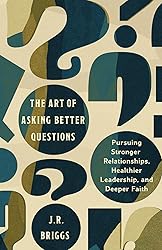
A Review of
The Art of Asking Better Questions: Pursuing Stronger Relationships, Healthier Leadership, and Deeper Faith
J.R. Briggs
Paperback: IVP, 2025
Buy Now: [ BookShop ] [ Amazon ] [ Kindle ] [ Audible ]
Review by Diane Roth
Several years ago, my congregation’s leadership explored a book together about the value of asking better questions. The book was written from a strategic perspective, how relationships and businesses become stuck because of the questions and assumptions they made, and how we can shift our perceptions and become ‘unstuck’ by asking better questions. It was one of my many ‘aha’ moments that I have had about the value of questions, and the kinds of questions we ask, and don’t ask.
In fact, there are many books about the art and practice of asking questions available right now (I googled). In our lonely, disconnected and polarized age, this makes sense, especially from an interpersonal standpoint, as well as a strategic one. The Art of Asking Better Questions also treads this ground, helping us to learn to ask questions that help us to know one another better and be better colleagues, partners, parents and humans. I especially appreciated that he emphasized our need to be genuinely curious about one another, our experiences, and our lives.
But this book’s unique contribution to the literature of question asking is its emphasis on questions with regard to our faith and to our relationship with God. There are three kinds of questions that Briggs deals with in this book that I don’t believe I have read about in other literature in this genre. They are:
- The questions we ask ourselves
- The questions God/Jesus asks us
- The questions we ask God
All three of these areas are rich areas for reflection. Starting with 1: What kinds of questions do we ask ourselves (if any?) How can we ask ourselves deep and reflective questions that will nurture and deepen our faith? The author himself has a practice of living with a particular question, what he calls a “grand question” for six months, journalling and reflecting. One example of a grand question the author has wrestled with is “Why is it that the more right I think I am, the less kind I think I have to be”?
The author deals with the many times in scripture that God questions us, whether through Moses, the prophets, or Jesus. He delves into the reasons that Jesus asks questions, whether out of compassion (Who touched me?) or to challenge assumptions (why are you trying to trap me?) or to point toward hope and revelation (What do you want me to do for you?) He categorizes the types of questions Jesus asks, whether rhetorical or absurd, ordinary (direct) or rebuking. The point is: Jesus didn’t flinch from asking questions; neither should we. Questions can serve and deepen faith.
The author also deals with the questions that we ask God. He deals with the questions we ask, and the questions we perhaps are afraid to ask, or taught that we shouldn’t ask. He delves into scripture to notice the questions that people asked God, and those that people asked Jesus as well. One detail he notices is that most of the questions in the scriptures that people asked — were not answered. What do we make of that, theologically? And what does this tell us about the value of questions, in relation to the value of finding answers?
I appreciated that in the author’s research and resources there are many references to the practice of questioning in Judaism. He particularly highlights the practice of encouraging children to ask questions (at Passover, children ritually ask the four questions (beginning with “why is this night different from all other nights?”), as well as the rabbinic practice of chavruta. Chavruta is meant to be practiced in pairs, by rabbinical students, who delve deeper in scripture together in part by asking more and deeper questions about the scripture they are studying. Later, the author adapts the practice to use it by himself. He studies a passage by asking as many questions as he can think to ask.
The author acknowledges that while the use of questions as a faith practice is normative in Judaism, it might be uncomfortable for Christians at first. However, he makes a strong case that asking questions ought to be a more common practice, if we want to nurture a deeper faith.
One of the descriptions he uses for the faith practice of asking questions is that of a midwife. This is also a term used to describe spiritual direction — that direction is a matter of attending to something already being born. The right questions do not create faith, but they illuminate us on our journey.
I remember a number of years ago, I was leading a small Wednesday morning worship service with a number of retired people in my community. One of the women in the group offered a question that she had been asked as a teenager: “is it better to be out in the field but wanting to be in worship, but to be in worship, and wanting to be out in the field?” I asked her what her answer to that question was. “I’m not sure that I know,” she said. “Perhaps that is why I am still here. I’m still trying to find out.”
The book doesn’t claim that there are no answers, but it does make the case that, in faith as in life, it is the quality of our questions that makes the difference. It is at its heart a practical book, but there are deep theological resonances here. Who will explore these resonances? What do our questions reveal about God, and about us?
This book is a good starting place.

Diane Roth
Diane Rothis a retired pastor and spiritual director, practicing the presence of God, however imperfectly. She writes at https://dianeroth.substack.
 Reading for the Common Good From ERB Editor Christopher Smith "This book will inspire, motivate and challenge anyone who cares a whit about the written word, the world of ideas, the shape of our communities and the life of the church." -Karen Swallow Prior Enter your email below to sign up for our weekly newsletter & download your FREE copy of this ebook! |
 Understanding Christian Nationalism [A Reading Guide]
 |
 Most Anticipated Books of the Fall for Christian Readers! Most Anticipated Books of the Fall for Christian Readers!
|
 Hilarious One-Star Customer Reviews of Bibles Hilarious One-Star Customer Reviews of Bibles |