 Sustaining Non-Homogeneous Communities
A Feature Review of
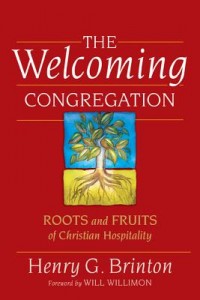
The Welcoming Congregation: Roots and Fruits of Christian Hospitality .
Henry Brinton
Paperback: WJK Books, 2012.
Buy now: [ Amazon ]
Reviewed by David Swanson
“You’re going to preach an entire sermon series about hospitality?” This was a friend’s confused response as I was sharing about my preaching plans. She conceded that hospitality might merit some discussion but couldn’t imagine that the topic warranted more than one sermon. Her perception, I imagine, is shared among many American Christians. In the secular realm hospitality is an industry; in our churches the word is associated with ushers, greeters, and those staffing the welcome booth in the lobby. How much can actually be said abut hospitality?
In The Welcoming Congregation: Roots and Fruits of Christian Hospitality Henry G. Brinton shows that there is plenty to be said about this often overlooked Christian practice. Brinton is the pastor of Fairfax Presbyterian Church and The Welcoming Congregation is the result of his travels visiting different hospitable Christian communities around the world: the Iona Community in Scotland, Saddleback Church in California, Reconciliation Parish in Germany, and the Washington National Cathedral in Washington DC. Divided into two sections – roots and fruits – Brinton attempts to show both the practices of hospitality and the results of those practices among what he calls “welcoming churches.” The author writes from a mainline church background and means for his book to be a very practical guide for churches interested in the “moderate religious middle.” Each chapter concludes with a series of discussion questions, an action plan for local congregations, and a suggested preaching topic. The Welcoming Church succeeds as a succinct, accessible, and creative guide to any church that is interested in reclaiming the priority of hospitality.
Central to Brinton’s understanding of what it means to be a welcoming congregation is the familiar line from Isaiah 56:7. Through the prophet the Lord declares that, “my house shall be called a house of prayer for all peoples.” Drawing from this and a handful of additional Biblical passages the author envisions congregations that welcome everyone. But this is not easy. He writes, “Most of us have a natural fear of strangers, and we are reminded every day of the political, racial, cultural, sexual, and economic distinctions that so often divide us. We know that we are most comfortable with people who look and act like ourselves, and that it is easiest to build community among groups of like minded-individuals.” For Brinton, hospitality must have roots deep enough to sustain non-homogenous communities within an increasingly divided culture.
The first of these roots described in the book are the biblical and historical precedent for Christian hospitality. The author draws from examples of hospitality throughout the Old and New Testaments, observes how Jesus’ practices hospitality, and gives a brief overview of hospitality in church history. This chapter is essential to the rest of the book as it demonstrates the essential role of hospitality in the lives of God’s people. While hospitality in the life of Israel looked differently than it does within our western culture, it is clear that this is not simply a culture-bound expectation that belongs in the past. The people of God have always responded to God’s welcome by caring for those on the margins. Brinton points to the many commands in Deuteronomy and Leviticus meant to shape Israel into a people who offer the compassion and care they had been denied for hundreds of years in Egypt.
I was surprised to find Brinton devote less than two pages to the hospitality of Jesus. He sees Jesus continuing the narrative of Israel by demonstrating boundary-breaking hospitality to “people who are on the margins of society, struggling with hunger, shame, disease, and homelessness.” He also usefully points out that Jesus offers hospitality not from a position of power but from weakness, in need of hospitality himself as he pursues his ministry.
But is this enough? Throughout The Welcoming Congregation Brinton repeatedly, and rightly in my opinion, shows the many obstacles to living hospitably. At each of the communities he visits it is clear that hospitality doesn’t simply happen. In Germany he visits The Chapel of Reconciliation, built in what was once known as the death strip separating East and West Germany. As described by the author, the work done by this church in the face of immense brokenness, shame, and anger is exemplary. Most readers will belong to churches located in less dramatic geography but the challenges to hospitable community are no less daunting.
It is these massive challenges to hospitality that require deeper roots than the author offers. As compelling as Jesus’ example is we need more than his example if we are to live the types of selfless lives that Christian hospitality demands. I’m glad Brinton does not make the mistake of skipping over Jesus’ life – our imaginations need the vision of a hospitable kingdom his actions and words provide. But more than a model of hospitality we need a conversion to discipleship to Jesus and this is what gets overlooked in The Welcoming Congregation.
For Brinton biblical hospitality looks like congregations that are “inclusive.” This is an important word for the author and he reserves his most sustained criticism for Saddleback Church for failing to “perceive the Bible as an unfolding story of ever-increasing inclusiveness” for their stance on LGBT issues. Whatever one’s understanding of these issues it seems that inclusiveness is not nearly a robust enough foundation for the kind of hospitality the author describes throughout the book. Perhaps, though, it is inevitable that inclusiveness is the best that can be hoped for when death and resurrection – Christ’s and ours – are left out of a theology of hospitality.
Despite these shortcomings Welcoming Hospitality has much to commend it. Henry Brinton’s pastoral disposition is wonderfully evident as he calls our churches to see and welcome the strangers among us. His descriptions of hospitable communities around the world helped me see my own church with a fresh perspective. And his extremely practical suggestions provide multiple entry points to any congregation interested in the ancient and vital practice of hospitality.
——
David Swanson is the pastor of New Community Covenant Church in Chicago’s Bronzeville neighborhood. He blogs regularly at davidswanson.wordpress.com .

C. Christopher Smith is the founding editor of The Englewood Review of Books. He is also author of a number of books, including most recently How the Body of Christ Talks: Recovering the Practice of Conversation in the Church (Brazos Press, 2019). Connect with him online at: C-Christopher-Smith.com
 Reading for the Common Good From ERB Editor Christopher Smith "This book will inspire, motivate and challenge anyone who cares a whit about the written word, the world of ideas, the shape of our communities and the life of the church." -Karen Swallow Prior Enter your email below to sign up for our weekly newsletter & download your FREE copy of this ebook! |
 Understanding Christian Nationalism [A Reading Guide]
 |
 Most Anticipated Books of the Fall for Christian Readers! Most Anticipated Books of the Fall for Christian Readers!
|
 Hilarious One-Star Customer Reviews of Bibles Hilarious One-Star Customer Reviews of Bibles |