 |
A Brief Review of
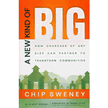
A New Kind of Big: By Chip Sweney Buy now: Reviewed by Brian Johnson. |
Are you interested in transforming your community? Is it possible to unite the churches in the community to bring about transformation? This book tells the story of how the Perimeter Church of Atlanta organized with other churches, within a 12 mile radius of Perimeter, to help meet the needs of the community: e.g., hunger, prostitution, etc. The author is the leader of an organization called Unite which works with other churches in the Atlanta area to meet community needs.
The author says, “[T]he problem with the church is not its size…the problem with the church is its reach.” The issue is not about a big church but it is about big needs, needs that are greater than any one church can handle. Thus the author hammers home two points that needs to be done to bring about community transformation:
1) Vision and
2) Collaboration with other churches and organizations within the community.
The author states that his vision for community action began with the junior high kids with whom he worked in Chicago. He shares the story of Brian, an avid hockey player, who decided to give away his prized hockey stick to a child in a transitional village for homeless families. The question then goes back to the church: how willing are we to free up resources – money, people, time – to reach out beyond the doors of our church building? This question is good not only for the mega-church but the small church as well. Another, more specific question that I would ask is how much money (percentage-wise) should be designated for staff members? It seems like in the mega-churches we have almost lost our sense of volunteering, most positions are paid positions. Along with how much money to spend for staff is another question on the heels of that, how much should we spend on our buildings? Does it help the kingdom to invest in bricks and mortar or in people?
The author then states that after their church began by establishing its vision, by addressing the “What if?”, question. They then began to answer the, “What now?’ question, which the author suggests, “is where great movements really begin.” Though their church planned for months for this ministry it moved beyond planning to doing. I liked the fact that one of the first things the church did was to partner with existing ministries versus beginning their own. I believe this is the toughest thing to do in any neighborhood or community. Join up and support existing ministries. Too often, we want the recognition of doing this ministry and supporting a existing ministry is just not going to give us the recognition we desire. For example, I wonder how many different churches have their own food pantries? Would it not be better to combine resources and have one big food pantry than many small ones?
After a lot of community research they decided to put their resources into 4 main areas: Families, Justice, Education and Poverty. They joined with an existing group to help those involved in the sex trade and also went into the public schools to help with tutoring and other needs. “Want to measure the level of poverty in your county?” Sweney says, “Simply track the number of free and reduced lunches in your public schools… our public schools are the alarm system for our communities, if we’ll just listen.” The author also tells what some churches in other parts of the country are doing in community transformation, in places like Knoxville, Long Beach and Little Rock.
The book closes with an appendix that stresses the need to build relationships and to see where Gods reign is already evident. In this appendix, Sweney offers principles for what he calls an asset-based approach to transformation:
1) God is already at work in the community
2) We are defined not by our problems but by our potential
3) Do ministry with people not to people
4) Effective ministry builds on assets.
A New Kind of Big is an enjoyable book that offers practical ideas for uniting churches for community outreach. If only our churches would catch the vision of working together in this way in every neighborhood and every community.

C. Christopher Smith is the founding editor of The Englewood Review of Books. He is also author of a number of books, including most recently How the Body of Christ Talks: Recovering the Practice of Conversation in the Church (Brazos Press, 2019). Connect with him online at: C-Christopher-Smith.com
 Reading for the Common Good From ERB Editor Christopher Smith "This book will inspire, motivate and challenge anyone who cares a whit about the written word, the world of ideas, the shape of our communities and the life of the church." -Karen Swallow Prior Enter your email below to sign up for our weekly newsletter & download your FREE copy of this ebook! |
 Understanding Christian Nationalism [A Reading Guide]
 |
 Most Anticipated Books of the Fall for Christian Readers! Most Anticipated Books of the Fall for Christian Readers!
|
 Hilarious One-Star Customer Reviews of Bibles Hilarious One-Star Customer Reviews of Bibles |