

 Journeying into New Life
A Featured Review of
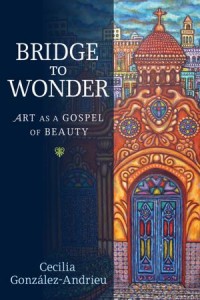
Bridge to Wonder: Art as a Gospel of Beauty
Cecilia González-Andrieu
Hardback: Baylor UP, 2012.
Buy now: [ Amazon ] [ Kindle ]
Reviewed by Chase Roden.
What is the purpose of art? While art’s definition is a matter of constant debate, with much of the 20th century’s artworks seemingly preoccupied with this question, it is somewhat less common now to inquire about the utility of art. In the art world it seems to be accepted as given that pure art is its own purpose; no other good must be attained or end accomplished other than the creation or performance of the work itself. In Bridge to Wonder, the first book from Loyola Marymount assistant professor Cecilia González-Andrieu, the author weaves together strands from theology, philosophy, and art criticism to make an argument that art has a vital purpose for Christians and for the world in general.
Of course, Dr. González-Andrieu is far from the first theologian to take on the task of perceiving the purpose of art – a fact that she is shrewdly aware of. The author makes broad use of wide ranging sources from Plato and Pseudo-Dionysius to Federico García Lorca in pursuit of her goal. Reflecting her own religious background, González-Andrieu draws particularly often upon Catholic thinkers, incorporating the writings of Pope John Paul II and Pope Benedict among many others on the topic of art.
Acknowledging the difficulty of universally defining art, González-Andrieu sidesteps the issue by choosing to define art not by what it is, but by what it does – and she believes art is capable of doing quite a lot. For the author, art has the potential to “confront and undo dogmatism, fundamentalism, and totalitarianism.” This capability comes both from art’s tendency to defy dualistic thought, and from its ability to present the viewer or participant with an experience of “undeniable otherness.” Properly used, art can be a gift artists offer society as a way to build human solidarity; it can be “a space beyond the known where we can journey into new life.”
González-Andrieu notes that “theological aesthetics is most fruitful when it deals with particular objects,” and this book is no exception. The author shows deep theological insight in her critiques of various artworks, from her description of a performance of the play La Pastorela by migrant farm worker actors in El Teatro Campesino, to a trenchant comparison of the Seeing Salvation exhibition at the United Kingdom’s National Gallery with the Royal Academy’s simultaneous Apocalypse. Her ability to find theological meaning in not just the works themselves but in the public’s reactions to them is quite profound. She critiques the film Inception brilliantly, describing its “cleverly designed and beautifully executed banality” as an unreflective, nihilistic, and ultimately deceptive depiction of a kind of hell and contrasting it with the “stark and ugly truth-telling” of Sarte’s No Exit.
Click the link below to continue reading on Page 2 …
 Reading for the Common Good From ERB Editor Christopher Smith "This book will inspire, motivate and challenge anyone who cares a whit about the written word, the world of ideas, the shape of our communities and the life of the church." -Karen Swallow Prior Enter your email below to sign up for our weekly newsletter & download your FREE copy of this ebook! |
 Understanding Christian Nationalism [A Reading Guide]
 |
 Most Anticipated Books of the Fall for Christian Readers! Most Anticipated Books of the Fall for Christian Readers!
|
 Hilarious One-Star Customer Reviews of Bibles Hilarious One-Star Customer Reviews of Bibles |





Nice review. It really makes me long to read this book. An interesting thought that came to mind, being a visual artist and having some trouble cohesively explaining the complete thoughts that drive my work but speaking of its application into different arenas and sometimes to specifics seems effortless, it might actually be the role of the church universal to place the artist and theologian in community to refine the purpose of art and create the space for them to work together. It might be too much to ask of one author, one book, or even for one community.
To build a bridge to understanding things about God, his glory, and his intention for the redemption of all things might be a larger and more complex task than any one person, community, generation, etc. could ever undertake. However, we must all place ourselves into the work with mind to our particular gifts.
Thanks for reading the review. I’m pretty sure the author of Bridge to Wonder would agree with your speculation about the role of church communities. She also writes in the book a bit about works of art as irreducible expressions — a good piece of art (according to her) will express what it does in a way that can’t be better expressed in a another form. If that’s true, it might simply be the nature of art that it doesn’t lend itself to explanation so much as application.
http://goo.gl/PNQEr