
 How the Virtues Help Orient Us Toward Christ
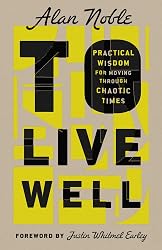
A Review of
To Live Well: Practical Wisdom for Moving through Chaotic Times
Alan Noble
Hardcover: IVP, 2026
Buy Now: [ BookShop ] [ Amazon ] [ Kindle ] [ Audible ]
Reviewed by Rachel Lonas
There is no shortage of media telling us how to be our best selves these days. My teenage daughters call it, “maxxing” life: productivity-maxxing, protein-maxxing, prayer-maxxing, personality-maxxing, looks-maxxing. Everything to the maxx.
In his latest book, To Live Well: Practical Wisdom for Moving through Chaotic Times, author and professor Dr. Alan Noble wants to point his readers to a Scriptural version of ourselves that bypasses all the modern hype. Christian virtues, he says, summarizing John Calvin, will lead the way by “faithful perseverance day by day and confidence in God to sanctify us” (174) so that we can love others well in a life devoted to Christ.
Noble’s target audience is college-age Christians. He points young people towards the seven virtues (four cardinal: prudence, justice, fortitude, and temperance; and three Christian: faith, hope, and love). His treatment of the virtues is preventative—a young person can consider them amidst the noise of the world and then pursue them, rather than clawing their way back to a life of virtue after building on a different foundation. But how you approach the virtues and the assumptions you make about the world will influence how you live them out—are the virtues compass points (guiding the way) or roadmaps (mandating specific turns)? The tone of To Live Well makes this unclear at times.
In each chapter, as Noble discusses how to apply a given virtue, his examples illustrate that preventative posture. He emphasizes pursuing in-person relationships, sacrificing for the greater good, staying chaste, parenting as the central purpose of marriage, keeping the faith despite doubts, finding an edifying job, receiving grace for failures, etc. At the same time, he treats delicately, almost warily, any intersection of virtues and Christian approaches to thornier issues, such as public education, addiction, poverty, and protest, that will doubtless impact his young readers, too.
He does weave a needed call to action throughout the book, remembering that we Christians are meant to look beyond ourselves in our everyday living. We are to be a community that cares for one another “even when it is inconvenient and uncomfortable” (51). God created us to live in interdependence, he says, not to be hyper-individualists as encouraged by our American culture. We must slow down moment by moment in order to pursue the virtues as we receive grace for the journey and use our time, talent, and treasure for mutual benefit in the Kingdom.
His admonitions, however, depend on his trust that certain institutions are safe places for those striving for virtue, while he displays a distrust of institutions outside of the approved ones. He assumes that, in general, a church or denomination’s leadership has a healthy, holistic view of ministry or that the young adult seeking a place in a church has the discernment to know the difference between a healthy or unhealthy (even abusive) religious space.
Noble’s way of communicating our call to a gospel-and-virtue-shaped life is uneven—sometimes peaceful and compassionate, sometimes anxious and strident. We are occasionally given sweeping generalities about ourselves and the world. Several examples:
When you love someone, your impulse is to want to make life easier for them, and so to confront them with their sin or even acknowledge there might be a better, more righteous way to live can feel like you are failing to love. But that’s backwards thinking…Love means being willing to burden someone for their own good! (152).
[S]ometimes ‘authenticity’ is only a story we tell ourselves to justify the pursuit of a lifestyle we hope will give us fulfillment (67).
The very idea that there could be good and bad objects of love is incoherent to the modern ear (144).
On the whole, our culture prefers us to excuse sin…we ‘let it be’ although it is bad; we ignore the evil; we don’t care; we’re indifferent; we don’t worry about it (150).
This advice flattens our dynamic experience of following Christ, requiring little curiosity, spiritual or otherwise, about why someone in or out of the church might be looking for something other than the antidote of faith, something that feels real in a fallen world. His jeremiads on the perceived erosion of our culture’s moral center could also feel burdensome to Christians who are already, by disposition or religious trauma, hyper-attuned to what the virtues require.
Noble’s tone and advice assume his young audience has access to wise, healthy social networks on which to draw. If they do, praise God and pursue them. But if not, is it possible to accept God’s good gifts of wise mentors not found in explicit Christian communities?
Many who have been part of Christian colleges and churches know that young people can look put together on the outside and yet misunderstand true virtue. Institutions tend to reward behavior more than character or turn more vulnerable believers into projects. Maturing in our faith is incredibly vulnerable spiritual work that might look to outsiders like a lack of commitment; we often move through cycles of faith and doubt that are not tidy. Perhaps because of the focus and audience of this book, he chose not to wade into how unaccessed emotions don’t always surface until mid-life—after someone has already joined that church, married that person, or chosen to have children following similar advice given in this book. In its pastoral reassurances, To Live Well is almost afraid to let faith get too messy or to ask questions from faith, not skepticism (114).
So while Noble does advocate for neighbor care and communal help, the book often veers toward individual solutions to systemic problems. Thus, he urges more accountability for the faithful churchgoer to ignite a virtuous community and less for the communal factors (unhealthy church leadership, predatory lending, economic inequality, healthcare access, etc.) that militate against the virtuous life he wants for his readers.
Stylistically, To Live Well feels more like a sermon series than an invitation to reflection—more monologue than dialogue. He focuses primarily on cultivating a will to act with divine guidance while missing the practices and diverse sources of community support that make sustained action possible.
Noble has always been a very gifted writer and thinker. In his interviews and talks he is funny, self-deprecating, and earnest in his God-given desire for us to live out the way of Jesus. As a parent of older teens, I understand his impulse for this book in an unstable world—pursuing virtue for the sake of the Kingdom, striving and failing, and relying on the Holy Spirit really does matter. Living a faithful life and committing to your community despite the hardships is a blessing to yourself, others, and God.
Noble calls readers to stand for the Gospel, knowing it’s going to cost us something while offering hope and joy. He says, “for the Christian, our ultimate hope is in Christ and his work of making all things new, which gives us the freedom to hope for people to change without placing our happiness or even contentment on their choices” (140). In the conclusion, he writes, “The past is filled with sins and errors of its own. But we can recover good fragments from the past. Pieces of truth, goodness, and beauty that point us to what we were created to be and who we were created to worship” (167).
These are comforting thoughts, but To Live Well’s interpretive omissions and overarching tone of certainty regarding those outside his corner of the Christian tradition hit me as a missed opportunity to encourage a broader audience in the mystery, complexity, and expansiveness of the Gospel. How could the seven virtues be found in the less traditional and more desolate places of life and service that his audience might encounter? These themes were more present in his previous, more personal book coping with religious scrupulosity and OCD—On Getting Out of Bed: The Burden and Gift of Living— and some of that vulnerability and charity could have helped this volume.

Rachel Lonas
Rachel Lonas is a writer and educator specializing in literature and composition. She enjoys her work in community development as a librarian and running her own tutoring business, as well as watercoloring and gardening. She lives in Chattanooga, Tennessee, with her husband, Justin, and their four daughters.
 Reading for the Common Good From ERB Editor Christopher Smith "This book will inspire, motivate and challenge anyone who cares a whit about the written word, the world of ideas, the shape of our communities and the life of the church." -Karen Swallow Prior Enter your email below to sign up for our weekly newsletter & download your FREE copy of this ebook! |
 Understanding Christian Nationalism [A Reading Guide]
 |
 Most Anticipated Books of the Fall for Christian Readers! Most Anticipated Books of the Fall for Christian Readers!
|
 Hilarious One-Star Customer Reviews of Bibles Hilarious One-Star Customer Reviews of Bibles |