
 A Poem is a Key
A Feature Review of
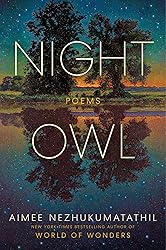
Night Owl: Poems
Aimee Nezhukumatathil
Hardcover: HarperCollins, 2026
Buy Now: [ BookShop ] [ Amazon ] [ Kindle ] [ Audible ]
Reviewed by Erin Beasley
If a poem is a key that unlocks a collection, Aimee Nezhukumatathil’s Night Owl has a whole ring of keys. One of these keys isn’t even a poem but the arrangement of the poems. Admittedly, this key sticks in the door for me or leaves me hovering upon the threshold of a dimly lit hallway. I know a structure exists within the sections; I sense the presence of other doors and rooms along the hallway; I simply remain unable to discern anything beyond vague contours. I find myself asking, “Why is this poem here instead of there?” It’s a worthwhile question, but I’m not sure I gleaned an answer from this collection.
I made the mistake of entering the book with an assumption: the poems would concern the night, or being a night owl, and each section would be devoted to the time period named by that section. That is sometimes the case. Other times, sunlight appears, which raises questions I have yet to answer satisfactorily. The key gives a little in the lock. I think if I spend more time here, with this lock, with this key, the door will open. I will step into a vast room and see there are yet more doors, yet more keys. It is one of the delights of this collection and of poetry. It unfolds itself only under patient care. And sometimes the key turns easily in a door that opens onto other rooms, other landscapes, seascapes, and the expanse of space.
Forms of writing and writing elements populate the collection: postcards; love notes scribbled while under a deadline; grammar lessons; punctuation; a few poems on the art of writing. The first poem begins with an alphabet.
One of the marvels of my life—
an alphabet. A whole green and mossy
world can be made and remade
from just twenty-six dark curlicues (3).
The final poem begins, “They never forget to write.” It continues, “the beauty of the sandpiper / is how fast its legs type / a love letter to the sea” (105).
What of other keys? A few more: a mother writing of and to her sons (“Saturnine,” “Almost Mercury”); a wife who adores her husband (“When You Are Near, I Turn into a Baja Fairy Duster,” “Green Love Poem”); a daughter who cherishes her parents even while acknowledging the complexity of their relationship (“Bloodflower,” “The Immigrant’s Very Good Daughter”); a woman who fervently and ardently loves both the sun- and dark-lit world.
Images and color, too, serve as keys. Fireflies glow, and hummingbirds, “with throats like nipped roses” thwum (“Hummingbird Abecedarian,” 20). Stone fruit pools in the hands and bees bumble. Greens and corals and blood-red color the pages. Dark marvels bloom: a spill of moonlight, berries thought past salvaging made into a pie, a woman scattered and gathered, “growing dark waxy leaves” (“American Tenderness,” 78).
The skeleton key, though, is love. Love pervades the book, from beginning to end. This is a book by a woman who has thought deeply about life in general and her life in particular. In meditating upon her life, she delights in it. In delighting in it, she meditates upon it. Every poem expresses love—love for the endangered natural world; love for her beautiful, gentle sons; love for her husband, the one who teaches their boys gentleness; love for her parents; love for the girl she was and the woman she is now.
This is not love in the abstract, but love concrete, love made real through “twenty-six dark curlicues” (3). This is love conveyed through admiration, joy, grief, worry, and anger.
Consider the poem “This Is Not a Sad Sight.” The speaker remembers her sons pre-mourning their dying goldfish, their once-upon-a-time insistence on wearing matching pajamas, their young tongues twisting around the name “Hephaestus”—and all of it fills the speaker with such acute sorrow, longing, and love that she says, “The very remembrance fills their mother’s / heart with so much magma, it might erupt” (93).
One poem is voiced by a speaker who converses with “angry underwater / ghosts in other languages I forgot I knew” (49). Here, the speaker finds grief—fewer fish swim this year than last year, and the year before that—and hope: “Why else would they activate their trigger fin / and hold on to coral bones if there was no more hope // of saving the bay?” (49–50).
If a collection of poems is a house, a single poem can serve as a key. For me, the keys to this collection were critical, for Night Owl is a vast house, endlessly sprawling. Using one key, and then another and another, helped me find my way. It might be an odd way to read a collection of poems, but whenever I felt some misgiving, I recalled other words Nezhukumatathil has written:
Maybe what we can do when we feel overwhelmed is to start small. Start with what we have loved as kids and see where that leads us.
For me, what a single firefly can do is this: it can light a memory I thought was long lost in roadsides overrun with Queen Anne’s lace and goldenrod, a peach pie cooling in the window of a distant house. (World of Wonders, 159)

 Reading for the Common Good From ERB Editor Christopher Smith "This book will inspire, motivate and challenge anyone who cares a whit about the written word, the world of ideas, the shape of our communities and the life of the church." -Karen Swallow Prior Enter your email below to sign up for our weekly newsletter & download your FREE copy of this ebook! |
 Understanding Christian Nationalism [A Reading Guide]
 |
 Most Anticipated Books of the Fall for Christian Readers! Most Anticipated Books of the Fall for Christian Readers!
|
 Hilarious One-Star Customer Reviews of Bibles Hilarious One-Star Customer Reviews of Bibles |