
 A Living Tradition.
A Review of
Two Recent Books on the Psalms:
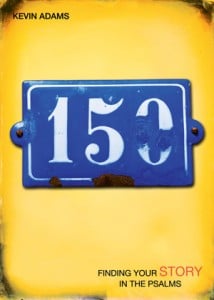
150: Finding Your Story in The Psalms
Kevin Adams
Paperback: Square Inch, 2011.
Buy now: [ Amazon ] [ Kindle ]
*** The Kindle ebook is only $0.99 for a limited time…
Mulled Psalms: Moving from I to We
Marjorie Gray
Paperback: Wordclay, 2011.
Buy now: [ Amazon ]
Reviewed by Rachel Diem.
I feel very grateful to have read these two very different approaches to the Psalms together, dipping into Marjorie Gray’s Mulled Psalms between the chapters of Kevin Adams’s book. The books complement and challenge each other in interesting ways.
The stories in Kevin Adams’s book invite us to see the psalms through the lives of other people, and to bring the psalms into our own daily experience. Those who are already familiar with the Psalms may not find this book as engaging or useful as those new to Bible-reading, but for those who want an introduction, this friendly book might be just the guide they seek. Adams’s book offers the Psalms as a way to find a spiritual community – with the psalmists and all other pray-ers of the Psalms throughout history – a community that accepts your own personal mess and your own spiritual strengths, whatever they may be. Adams encourages readers to bring both our faith and our doubt, our praise and our grief, our fury and our outrage to the Psalms – the full range of our human experience and emotion – and assures us we will find ourselves represented there.
In each chapter, a psalm (or group of psalms) is introduced, and stories are told related to that psalm: how it touched the life of the author, someone he knew, in person or through his reading. By example, Adams tries to show us how to find our own stories and our own lives in the psalms. He encourages us to read the psalms regularly, to engage them deeply. The title is a bit misleading, as far fewer than 150 psalms are discussed, but Adams does a good job introducing a variety of psalms including lamentations, praise songs, those he calls “battle hymns” and others.
Those of us who have been reading and praying the Psalms for a while may enjoy 150, but not find it as useful as new Psalm-readers. Those already reading Psalms regularly may find 150 most useful as an introduction to other writing on the Psalms, including C.S. Lewis, Thomas Merton, and many others – and to adaptations of the Psalms in the works of artists as varied as Kanye West and Johann Sebastian Bach.
Adams writes briefly of his own congregation’s year-long engagement with psalm study. I wonder if the particularity of that congregation – Californian, Christian and suburban (possibly white and affluent?) – may inadvertently have narrowed Adams’s focus, and consequently his reading audience for 150. For example, Adams mentions that the Psalms are sacred to Jews and Muslims as well as Christians, but few Jewish (and no Muslim) writers on the Psalms are mentioned. And since I find myself now in critical mode, I might mention that some readers may be annoyed by Adams’s habit of referring to a person or a time in history without naming it for a paragraph or two, as if we are supposed to guess.
And then I ask myself: if people who are unfamiliar with the Psalms as prayer, as a spiritual resource, find this book helpful – if even one such person finds the book useful, then those criticisms pale in comparison with that achievement.
Marjorie Gray’s Mulled Psalms is – in my mind at least – a collection of 150 new psalms, each with a clear and vibrant connection to the Biblical psalm with which it shares a number, but completely able to stand alone. In a collection of any 150 poems, readers will have their favorites and some will be more successful than others, and this is no exception, although, based as it is on the Psalter, Gray’s collection has a unity that many poets would envy. Gray’s language is leaner and more abrupt than any translation of the Psalms I’ve read. This works for some poems but not for others. Where a rhyme scheme and syllabic count are imposed (for example, 40) Gray’s language has an awkward elegance.
We are patients in God’s waiting room:
wretched and weeping we waited until
Someone heard us crying, drew us from gloom
to gladness, murky swamp to lofty hill.
Some readers will start at the beginning, but I imagine that most will go first to the psalm-poems that correspond to their own favorite psalms, or that correspond to psalms that cause them some difficulty. I went to lifelong standards 23 and100 first; 100 is as direct and joyful as its Biblical ancestor-cousin, as is 150; and 133 and 134 may be more accessible to contemporary readers than their counterparts in the Bible. On the other hand, while 23 has a certain grace, the language is often so contemporary (words like “traumatizes” and “effervescent”, for example) that it feels jarring. And sometimes the mix of metaphors don’t work, as in 40. Gray convinced me, though, with her re-visioning of 137. While some readers may miss the willows of Babylon, Gray has opened the psalm to include us all, both as perpetuators of violence and as people aching for peace.
All around the world
songs are dying; people are crying
with longing for peace.
It’s a wonderful companion to the Biblical psalm.
The overall sense of this lovely collection is that the Psalter is a living tradition, available to our contemporary lives and needs – where we can “find our stories” as Kevin Adams suggests. Maybe the highest praise of Gray’s work is that it will tempt you to try your own re-workings of the Psalms.

C. Christopher Smith is the founding editor of The Englewood Review of Books. He is also author of a number of books, including most recently How the Body of Christ Talks: Recovering the Practice of Conversation in the Church (Brazos Press, 2019). Connect with him online at: C-Christopher-Smith.com
 Reading for the Common Good From ERB Editor Christopher Smith "This book will inspire, motivate and challenge anyone who cares a whit about the written word, the world of ideas, the shape of our communities and the life of the church." -Karen Swallow Prior Enter your email below to sign up for our weekly newsletter & download your FREE copy of this ebook! |
 Understanding Christian Nationalism [A Reading Guide]
 |
 Most Anticipated Books of the Fall for Christian Readers! Most Anticipated Books of the Fall for Christian Readers!
|
 Hilarious One-Star Customer Reviews of Bibles Hilarious One-Star Customer Reviews of Bibles |