
 Worship as a Formative Tool for Imagination

A Feature Review of
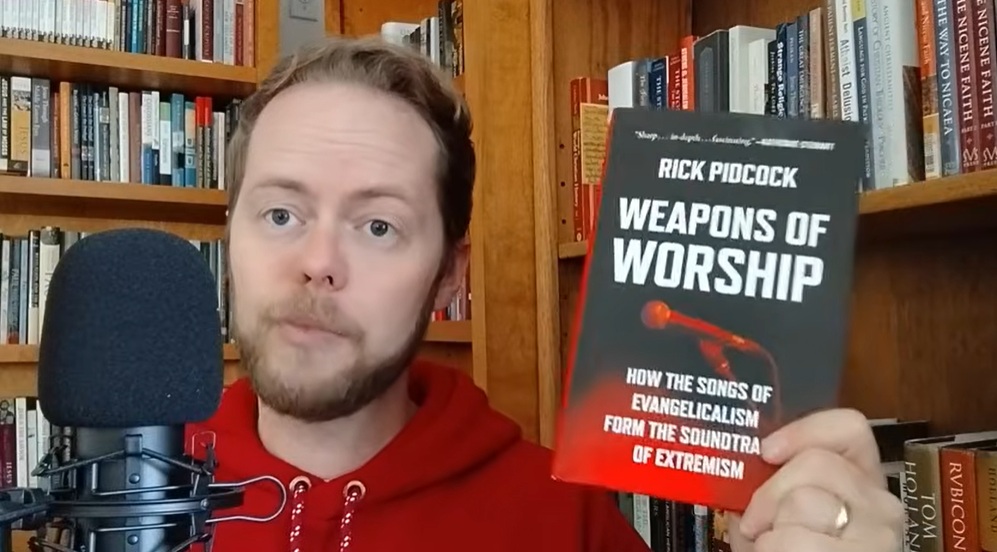
Weapons of Worship: How the Songs of Evangelicalism Form the Soundtrack of Extremism
Rick Pidcock
Hardcover: Broadleaf Books, 2026
Buy Now: [ BookShop ] [ Amazon ] [ Kindle ] [ Audible ]
Reviewed by Daniel Jesse
I spend a lot of time thinking about worship songs. Usually, I am asking theological questions. What does a song say about God? What does it say about us? What does it teach us to hope for? Rick Pidcock’s Weapons of Worship: How the Songs of Evangelicalism Form the Soundtrack of Extremism forced me to ask a somewhat different and more uncomfortable question: What if the most important thing about a worship song isn’t simply what it says, but what it is teaching us to imagine?
Pidcock is interested in the relationship between contemporary evangelical worship and Christian extremism, particularly Christian nationalism. The question driving the book is intentionally provocative: how did the music of evangelical churches become usable as the soundtrack of a political movement organized around power, authority, enemies, conquest, and submission? The connection is not accidental, in Pidcock’s telling. It emerges from a larger worship culture shaped by theology, the worship industry, celebrity leaders, political movements, and increasingly the algorithms that determine which songs circulate among churches.
That is a big claim, and it would be easy to reduce it to an argument that certain worship songs are secretly political propaganda. But I think Weapons of Worship is more interesting when read as a book about Christian formation.
Pidcock spent twenty years as a worship leader before becoming a journalist and critic of evangelical culture. He describes once understanding worship as a response to God’s revelation, something that magnified God’s supremacy and called Christians to offer their whole lives to God. His later theological education caused him to reconsider the assumptions about power embedded in that understanding, particularly the language of empire, hierarchy, authority, and submission.
That autobiographical dimension matters because Pidcock isn’t writing about worship as an outside observer. He knows what it feels like to stand in front of a congregation and invite people to sing these songs.
I know something of the world he is describing. These aren’t obscure songs performed on the fringes of evangelicalism. They belong to the musical ecosystem that has shaped contemporary evangelical worship for decades. They come from artists and organizations such as Bethel Music and Hillsong, and from the larger worship industry that determines which songs move from album to conference to Spotify playlist to Sunday morning. Pidcock traces those connections from contemporary worship gatherings back to the development of contemporary Christian music itself.
His argument gets especially interesting when he turns to the language worship gives us: Enemies. Victory. Warfare. Power. Submission. Conquest. Judgment. None of those words, by themselves, proves anything. Christianity has always contained the language of spiritual struggle. The Psalms certainly mention enemies. Revelation has beasts and battles. Christian hymnody has hardly been pacifistic in its imagery. The question is what happens when that vocabulary becomes part of a larger imaginative world.
Pidcock argues that contemporary worship can reinforce structures in which those at the top possess power, those below are expected to submit, and people outside the movement become enemies. He sees that vocabulary crossing increasingly easily between worship gatherings and political rallies.
I agree with Pidcock that worship is not just theology set to music. Songs don’t just make propositions. They give us roles to inhabit. They teach us who “we” are. And sometimes they teach us who “they” are.
We sometimes evaluate worship songs as if they were miniature systematic theologies. Pull the lyrics onto a screen. Examine each sentence. Determine whether anything is heretical. If everything survives inspection, the song passes. But worship doesn’t work that way. Music involves bodies, repetition, emotion, memory, community, and belonging. Singing something together is different from reading the same sentence in a theology book. Pidcock’s central concern depends upon precisely that difference. Singing together creates belonging and transcendence, which raise the stakes considerably when the musical language of worship crosses into political movements.
That strikes me as one of the book’s most important insights: A lyric does not have to contain an explicit political statement to participate in a political imagination. Imagine repeatedly singing about being an army, defeating enemies, taking territory, submitting to authority, or anticipating divine judgment. Again, none of those images necessarily leads somewhere sinister. Some are deeply biblical. But formation happens through accumulation.
A song exists within a repertoire. A repertoire exists within a liturgy. A liturgy exists within a church. A church exists within a political and economic culture. Eventually the question cannot simply be, “Is this lyric technically orthodox?” We also have to ask: “What kind of people is this way of worship teaching us to become?” That is a much harder question.
Of course, just because a song contains warfare imagery does not mean the person singing it will become a Christian nationalist. Nor does the political use of a worship song exhaust what that song means to Christians who have sung it in grief, fear, repentance, or hope. Context matters enormously. The same language can operate differently in different communities. Biblical language about victory can become triumphalist in the hands of the powerful while becoming language of survival among people who actually live beneath oppressive power. That distinction matters. Otherwise, critique begins reproducing the flattening it is trying to expose. Worshippers cease to be people and become evidence.
Pidcock’s journalism is most valuable, I think, when it keeps us looking at systems rather than merely hunting suspicious lyrics. The book investigates not only theology but an industry: megachurches, worship collectives, celebrity worship leaders, political rallies, and algorithmically shaped repertoires. That makes his argument much stronger than “warfare songs are bad.” He points out that the deeper problem is the ecosystem in which those songs become meaningful.
Pidcock’s analysis of the worship industry might be the part of the book Christians most need to think about. Most congregations do not produce their own musical theology from scratch.
Songs arrive, through conferences, recordings, worship collectives, publishing arrangements, streaming platforms, social media, celebrity worship leaders, and recommendation algorithms. Pidcock investigates how algorithms help define church repertoires and how a relatively small group of influential worship organizations and leaders exercises enormous cultural influence.
We like to imagine that a church chooses songs because the worship leader prayerfully searched for music appropriate to that particular congregation on that particular Sunday. Sometimes that happens. But the menu has already been made. Before the worship leader chooses a song, someone has decided which songs get recorded, marketed, streamed, recommended, covered, placed on playlists, performed at conferences, and heard often enough that the congregation recognizes them. Theologically, that’s significant. The contemporary worship canon has curators, and some of those curators are corporations and algorithms.
Songs train attention. They teach us what deserves our concern. They tell us what counts as a threat, what victory looks like, whose suffering matters, and what kind of future we should desire. If our songs continually teach us to imagine the Christian life through domination, enemies, victory, power, and escape, we should at least wonder what becomes harder for us to imagine: Interdependence. Creatureliness. Grief. Repentance. Care. The slow repair of damaged things. Love for a world we cannot conquer and do not own.
The alternative to weaponized worship is not simply better lyrics. It is a different imagination.
Weapons of Worship should not leave us afraid of worship music, nor do I want every worship service to become an ideological screening exercise where each metaphor is interrogated for hidden political content. That’s another way of forgetting what music is for. But Pidcock has convinced me that Christians need to ask harder questions about the songs we sing. Is this biblical? Do I like this song? Does this song help people worship? What does this song ask me to love? Who does it teach me to fear? Where does it locate power? Who are the enemies in the world it imagines? What does salvation look like here? Who might I become if I sing this every Sunday for ten years?
That last question is the one I’m carrying with me after Weapons of Worship, because worship songs don’t disappear when the final chord fades. They become memory. They become instinct. They become the language we reach for before we have time to think. They become part of us.
And if Pidcock is even partly right, then choosing the songs of the church is more consequential than just deciding what we are going to sing on Sunday. We are choosing some of the words through which Christians will learn to imagine the world. And we should probably be more careful about the worlds those words create.
For anyone interested in worship, Christian nationalism, contemporary Christian music, or the relationship between liturgy and formation, Weapons of Worship: How the Songs of Evangelicalism Form the Soundtrack of Extremism deserves a serious reading, including by readers who expect to disagree with parts of it. Honestly, disagreement may be one of the better reasons to read it. It is provocative, occasionally uncomfortable, and particularly valuable when it moves beyond individual lyrics to examine the larger systems that produce and circulate contemporary worship music. Pidcock’s strongest challenge to us isn’t that singing a particular song turns someone into an extremist. It is that Christians have too often underestimated the formative power of worship itself.
The question underneath Pidcock’s book is bigger than whether we approve of contemporary worship music. It is whether we really believe what we have been saying for centuries: Worship forms us. If we do believe that, then we have to be willing to ask what it is forming us into.
[ LISTEN to our podcast episode featuring Rick Pidcock and Daniel Silliman. ]

Daniel Jesse
Daniel Jesse is a Humanities and Theology Professor working with AI inside and outside of the classroom, a Christian Worship researcher, and occasional preacher. He writes about Emotional Formation in the Church on Substack at: danieljesse.substack.com
 Reading for the Common Good From ERB Editor Christopher Smith "This book will inspire, motivate and challenge anyone who cares a whit about the written word, the world of ideas, the shape of our communities and the life of the church." -Karen Swallow Prior Enter your email below to sign up for our weekly newsletter & download your FREE copy of this ebook! |
 Understanding Christian Nationalism [A Reading Guide] |
 Most Anticipated Books of the Fall for Christian Readers! |
 Hilarious One-Star Customer Reviews of Bibles |