
 Some Disassembly Required
A Feature Review of
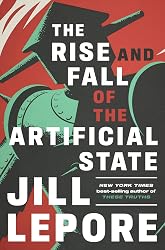
The Rise and Fall of the Artificial State
Jill Lepore
Hardcover: Liveright, 2026
Buy Now: [ BookShop ] [ Amazon ] [ Kindle ] [ Audible ]
Reviewed by Rachel Goddard
To understand The Rise and Fall of the Artificial State, you must understand Lepore’s underlying assumption: constitutional democracy, liberal nation-states, and humanity are better than tech companies’ vision of rule by automation, government by machine, and replacement by AI. Since readers of this publication likely share this assumption, I won’t argue it, but I hope that all of Lepore’s readers do also. I never thought I’d need to defend the liberal world order when I was a bright-eyed, naïve political science student in the late aughts. Oh well.
Lepore begins with defining terms, the most important of which is “Artificial State”: “less a state than a dream of being without one, the dream of severing humans not only from the natural world but from one another…a dream of escape from the constraints of nature and even from the burdens of being human, and especially from the obligations of human family, society, and government” (xv). Lepore the historian takes over in “Part One: Government by Machine.” She explains that, according to Thomas Hobbes, the state is not natural—states are artificial because they are invented by humans (4). The qualities of states and nation-states depend on technology; constitutional democracy, for example, relies on pen and paper (4). Therefore, the late 20th century’s return to autocracy from the height of liberal democracy, in Lepore’s telling, was the result of intensified automation and government by machine, driven by computation, prediction, and persuasion. “The corporations that owned these machines began to subsume the state” (4). This is what Lepore claims is the thesis and thrust of the rest of the book; I am not convinced she fully proves it.
Part two of Lepore’s argument is that the Artificial State is different from Hobbes’ because today’s machines are destroying the natural world (5).
“The Artificial State is an unfinished digital communication infrastructure with which governments and especially private corporations organize and automate political behavior and public discourse by way of everything from direct mailing and robocalls to predictive algorithms, social media campaigns, AI agents, and bots (programs that mimic and often pass as humans)…nearly every element of public and democratic life…is vulnerable to subversion through the reduction of politics to the digital manipulation…The liberal nation-state requires the consent of the governed…the voice vote…the raised hand…the signature…the heart…The Artificial State is government without consent, even government without humans. It is the severing of humans from one another and the replacement of human discretion with machines that predict, manipulate, and control human desires and decisions” (5).
Lepore states outright she is not anti-technology but rather against technology’s unthinking and incautious effects on democracy. She argues we are participating in our own dehumanization, something any number of thinkers, Christian and secular, have cautioned for decades (5). She claims the Artificial State’s construction was slow and unintentional for the most part until the end of the 20th century, but those days are over. It is now deliberate and far too fast (7). Automation breeds mistrust in the government for its citizenry and cowardice in the leadership (9).
Lepore’s impassioned argument that tech company leaders’ obsession with freeing us from the constraints of our human bodies and Earth struck me as straight from the Tower of Babel and finds its echoes in overuse of GLP-1s by people already too thin and Botox by those too young (15). She also forces readers to wonder whether we as Americans are ready to ask ourselves if we feel comfortable bearing the moral weight of having created and exported yet another tool that could wreak havoc on the world, when we already have social media to our credit? It is a sin as old as humanity itself, worshipping something our own hands have made (16).
Lepore is strongest in the first half of The Rise and Fall of the Artificial State, tracing the slow movement of technology into America’s democratic machinery. She follows the development of the Artificial State, from its basis in the Enlightenment’s foundations in “fact” ruling society as the basis of all truth, to numbers, as populations grew and had to be counted, to “data,” when a number was so big only a machine could handle it (24). Democracy lives or dies by numbers (how else would we know who won a vote?), but those numbers must be tied to actual people, or democracy collapses (22-23). When numbers become data and must be handled by machine, we all become just numbers on a screen, to be sorted and filtered and microtargeted.
Since I’m reading the Bible in a year with my husband and my church, and we’re smack in the middle of Ezekiel, the warnings of many mathematicians and sociologists and scientists about the likely downsides of the new technology on American democracy and culture felt eerily relevant (42, 60). Her conclusion to this section is that we didn’t have to be in our current situation; “it played out the way it did because of the failure of liberal democracy to limit corporate power over politics and government, its failure to heed decades of warnings about the dangers of an automated state” (69).
The second half of the book, “What Robots Want,” requires more careful reading. I struggled to follow Lepore’s connections sometimes. I think her argument is that the fear of a robot uprising among the very men building the technology that will make it more likely is linked to human’s domination of the animal and natural kingdoms. The question is whether I buy it (126). And I guarantee you the tech bros can’t articulate it. One striking statement that did land was, “For the last four centuries, humans have wiped or nearly wiped out entire species to maximize the making of, essentially, paper clips” (127). Anyone familiar with the AI debate currently raging will recognize the reference to the paper clip maximizer thought experiment. Lepore also claimed that automaton development and the vivisection debate were intertwined in the Victorian era, then continued that same argumentation throughout the second half of her book, but none of her sources that I could tell directly made that link (146).
Lepore develops several themes throughout her book. First, the tech magnates that rule our time are recycling old ideas with new toys. I almost fell out of my chair when, at the end of a chapter on a bizarre 1920s-1930s ideological movement, one of the leaders turned out to be Elon Musk’s grandfather (36). It turns out that many of Musk’s current beliefs (I say current, as Lepore traces the radical changes the tech leaders have made in their ideology) are straight out of the Technocracy movement or, worse yet, science fiction.
That is Lepore’s second theme: that tech magnates get most of their ideas from reading science fiction, but they read it wrong (120). To many in Silicon Valley, according to Lepore, science fiction is an instruction manual, not a means of critiquing earthly social and cultural conditions in the authors’ own time, or even warning of technological egotism. Lepore includes a history of science fiction, likely as a means to give the necessary context the Silicon Valley leaders should have as they read their sacred text: technology is not neutral and generally ends up badly for humans. They end up taking the wrong lessons from Asimov and his brethren and instead continue humanity’s destruction of the natural world. A new philosophy to which they adhere, long-termism, teaches them that as long as they are concerned with the outcomes for humans millennia in the future, they are fine. To any normal person, this misinterpretation would be ludicrous (121).
Lepore is on more solid ground with her conclusion: “Disassembly requires identifying and naming the parts, discovering where they came from and how they were made, and figuring out how they were put together. It requires, that is, a history” (223). It is this history Lepore has tried to construct. She mostly succeeds in writing an accessible history of how we let people become data and consent of the government become decision by prediction and machine. She doesn’t attempt to outline how we get out of it—that’s not her job as a historian. That’s ours.

Rachel Goddard
Rachel Goddard is an insatiable bookworm and avid crafter. She is the Director of Operations for a small non-profit, after 14 years with the federal government. She holds a master's in Defense and Strategic Studies from Missouri State University and a Bachelor's in Political Science and International Relations from William Jewell College in Liberty, Missouri. She lives in Northern Virginia with her husband, Richard, and her cat, Izzy.
 Reading for the Common Good From ERB Editor Christopher Smith "This book will inspire, motivate and challenge anyone who cares a whit about the written word, the world of ideas, the shape of our communities and the life of the church." -Karen Swallow Prior Enter your email below to sign up for our weekly newsletter & download your FREE copy of this ebook! |
 Understanding Christian Nationalism [A Reading Guide]
 |
 Most Anticipated Books of the Fall for Christian Readers! Most Anticipated Books of the Fall for Christian Readers!
|
 Hilarious One-Star Customer Reviews of Bibles Hilarious One-Star Customer Reviews of Bibles |