
 A Rhythm as a Rule of Life
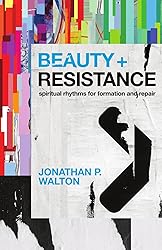
A Review of
Beauty and Resistance: Spiritual Rhythms for Formation and Repair
Jonathan P. Walton
Paperback: InterVarsity Press, 2025
Buy Now: [ BookShop ] [ Amazon ] [ Kindle ] [ Audible ]
Reviewed by Murphy Alvis
Are you aware of all the factors that shape your experience, choices, and attitudes? If the impact of Richard Thaler’s Nudge on public policy is any indication, you and I might not be as aware as we wish. What’s worse, though, is that others are. There is power in seeing how big-picture dynamics impact our individual lives; at some level, the more we know about powerful currents just beneath the surface of the water, the less likely we are to drown. This idea lingers with me after reading Jonathan P. Walton’s Beauty and Resistance: Spiritual Rhythms for Formation and Repair.
Walton is writing a book on rule of life, not from a theoretical position but from his own sense of desperation – in the midst of a life committed to advocacy, ministry, and justice work, Walton caught a vision of a much-needed antidote to his experience of burnout:
“Jesus called me to a rule of life organized not just around lamenting or rejoicing but around both in full measure, along with rest and work. He called me to four practices: rest, restoration, resistance, and repetition. And I believe he is calling you too. Not just because we live in a particularly difficult time where special practices and disciplines are needed, but because abundant reception of and involvement in beauty and resistance are marks of a life lived with God” (10-11).
His premise is that the four practices are for all of us. He makes this case through his engagement with colonial critique, which is a beautiful and new take on the topic of “rule of life.” Following introductory material that tells us a bit of his story, he structures Beauty and Resistance around these key areas, in all of which we encounter entropy or active hostility to our lives with God.
In Chapter Three, he addresses why we can’t rest and why rest is so fundamental to a life marked by God’s presence and activity. Chapter Four asks “Why can’t we be restored?” and focuses on the forces that keep us on the back foot. In Chapter Five, probably the most original chapter of the book, we see Walton wrestle with identifying where a God-shaped life must also include resistance. He draws everything together in Chapter Five, where he outlines a process for codifying the discoveries of the previous three chapters into a rule of life (which, for him, is the fourth practice of his rule of life). Even as a white, middle-class man living in the midwestern United States, my experience is colored (often to my benefit) by the colonial milieu that has shaped my country. In rest, restoration, and resistance, we are able to navigate the tension of engaging with beauty while also refusing the yoke of all the structural, ideological, and spiritual weights that work to dehumanize people.
These forces of entropy and hostility, which he refers to as “powers and principalities” in multiple places, are particularly good at targeting those on the underside of privilege; unfortunately, they are also excellent at camouflaging themselves from those on the upside of privilege. However, Walton paints a compelling picture that shows how these things dehumanize all of us by creating systems of separation. He writes,
“The effects of the terrible temptation to see ourselves above and separate from one another and creation instead of integral parts of both persist and must be pushed back against. Colonization, or the remaking of the world into the image of the dominant individual, group, class, country, and ideology, opposes the notion that we are made in the image of God, designed to reflect his image and live in his kingdom” (91).
This quote gets at the primary unique contribution of Walton’s book: contextualizing “rule of life” as a method of resistance against colonial pressures. If “Humanity was made out of love for love, justice, and shalom – peace between all relationships,” then colonialism is one of the primary things that distorts love, justice, and shalom (11).
His whole fourth chapter (on the discipline of resistance) makes a compelling case for active engagement against darkness as a necessary aspect of faithfulness, which, from what I have seen, is often ignored in books on spiritual formation and developing a rule of life. Without a rule of life, I will capitulate to the pressure of a reified colonial ideology that invites me to choose convenience and corner-cutting to avoid conflict, and I will see myself as better, more deserving, or somehow “different” from the “other” who, for some reason, isn’t like me (116-117). It seems that as we resist by naming and engaging the cultural structures, we are able to see all the small ways we are conditioned to dehumanize ourselves and one another.
I haven’t read another book on developing a rhythm of life that deals so clearly, compellingly, and plainly with the need to prioritize resistance as part of the spiritual life and the reality of the racialized world that impacts our spiritual lives.
While I think that Walton’s work in this book is unique and his prose and poetry both make the topic more accessible, I can’t shake the feeling that this book suffers from the “protocol” problem. That is, the book implies that taking the structures, examples, and rhythms at face value will beget transformation. And maybe they will. The concrete examples often translate to a “how to” sensibility, a tacit “if you do what I do, how I do it, then you will get my results.” This protocol creates excellent handles, but I think it inadvertently leads to knowledge without wisdom: more examples of how to “fix your life” without the lived experience of discovery and struggle out of which transformation occurs.
This, I think, ultimately stems from his definition of rule of life: “A rule of life is a set of intentional practices that support long-term, prayerful growth” (11). This is good, but growth is not what rules of life are designed to produce (if production is a sensible metaphor at all); rules of life are meant to orient our attention toward God as the center of our experience. Communal rules help shape the way communities see everything: pain, prayer, work, and one another. Growth is an outcome of a great rule of life, but I don’t actually buy that it is the chief end; personal growth in Christ always lags behind our attention to God’s work and presence in our lives. While Walton’s advice and structure make good sense, I felt like I was left wondering: what’s God’s part in all this, and how would I even know what he’s doing?
This critique notwithstanding, there is a lot to love about Jonathan Walton’s Beauty and Resistance. In a time when it is easy to reduce spiritual formation to behavioral modification, he draws our gaze to a 30,000-foot view of the cultural dynamics shaping us. Framing his rule of life within the context of colonialism and his emphasis on resistance as a discipline for the spiritual life are both exceptional and, to this point, unique contributions to the conversation, worthy of reading.

Murphy Alvis
Murphy Alvis is a lead mentor for The Companion: Apprenticeship in Spiritual Direction at the Apprentice Institute at Friends University, a PhD student at the University of Aberdeen, and
serves as an adjunct professor, spiritual director, retreat leader, and consultant focusing on what it means to live and work in light of the with-God life. He writes (almost) weekly at the
growing Whatever Is Substack, focusing on spiritual formation and soul care. He lives in Southwest Missouri with his wife, Tasha, their two kids, and too many cats.
 Reading for the Common Good From ERB Editor Christopher Smith "This book will inspire, motivate and challenge anyone who cares a whit about the written word, the world of ideas, the shape of our communities and the life of the church." -Karen Swallow Prior Enter your email below to sign up for our weekly newsletter & download your FREE copy of this ebook! |
 Understanding Christian Nationalism [A Reading Guide]
 |
 Most Anticipated Books of the Fall for Christian Readers! Most Anticipated Books of the Fall for Christian Readers!
|
 Hilarious One-Star Customer Reviews of Bibles Hilarious One-Star Customer Reviews of Bibles |