
 The Flourishes and Flaws of C.S. Lewis
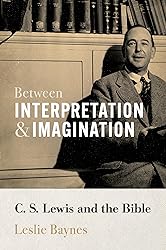
A Review of
Between Interpretation and Imagination: C.S. Lewis and the Bible
Leslie Baynes
Hardcover: Eerdmans, 2025
Buy Now: [ BookShop ] [ Amazon ] [ Kindle ]
Reviewed by Noemi Ortiz
Leslie Baynes’s Between Interpretation & Imagination: C.S. Lewis and the Bible takes us on a biblical and literary journey, offering fresh lenses with which to understand the scriptural influence on C.S. Lewis’s life and work. As a New Testament scholar, Baynes approaches this work with a scholarly eye and an investigative approach, revealing new materials that illuminate Lewis’s engagement with scripture. The author notes that this book will be of interest to those who want to learn more about Lewis, to biblical scholars who may or may not appreciate him, and to anyone who wishes to understand “how the twentieth century’s most influential writer…worked with the Western world’s most influential book.” As a lover of the Bible and an admirer of Lewis, I found this book a banquet.
A literary figure who read voraciously, Lewis respected the Bible. His life was saturated in it. He wrote about it in letters, referenced it in his literary works, and quoted it even in casual conversations. He wrestled with it but never abandoned it. Lewis had been familiar with the Bible since youth, but when he became a Christian, he consulted now unknown biblical scholars who could offer some guidance. It was enlightening to see the genealogy of Lewis’s influences, particularly from Church of England bishop Charles Gore, with whom Lewis ended up sharing major similarities on theological viewpoints; for example, Gore also believed that myth was a mode of apprehending truth. Even though Gore and others informed Lewis’s work, Baynes shows how Lewis deviated from them, not always in a good way.
Lewis could be considered a harmonizer, not dwelling in the weeds but seeing the forest—a rich forest of Christian core teachings upheld by the Church for centuries. Unlike biblical scholars of his day, Lewis minimized gospel differences. Rather, he approached the Bible as a literary work, convinced some parts were fictional. This literary instinct allowed Lewis to read scripture less rigidly, though he still believed that the Bible was God’s word. Christians today may feel as though they must belong to either a rigid literalism or hold skeptical criticism, but Lewis did not fit neatly into either camp.
While Lewis sought to harmonize, he failed to do his scholarly due diligence. According to Baynes, C.S. Lewis may have had on scriptural blinders. This caused him not to check his sources but instead rely solely on memory which, at times, could be faulty. In her investigation, Baynes scrutinizes Lewis’s mishandling of sources and is just as stumped as the reader about why he did so. Yet Baynes does not treat these failures as grounds for dismissing Lewis’s authority altogether. Instead, she presents him as a gifted lay theologian whose influence far exceeded his formal training. In this sense, Lewis inadvertently shows the responsibility that Christians bear for proper biblical interpretation and avoiding biases. Ultimately, Lewis’s blunders make him more relatable—both as a flawed human being who made mistakes but also as a layperson struggling to make sense of the Bible.
While his flaws came out in biblical interpretation, his strengths flourished in his imagination. Here we arrive at the glorious way Lewis infused The Chronicles of Narnia with Scripture, not by writing allegory, which Lewis explicitly rejected, but by embodying biblical truths through story. Lewis developed relatable and fantastical characters who exercised free will while encountering challenges amidst a battle between good and evil. Baynes highlights different themes found in each chronicle, showing how Lewis strategically uses Scripture and other literary devices in his narratives. To the reader’s delight, Baynes shows the masterful ways that are not so obvious—the subtle minutiae—that Lewis weaves into The Chronicles. Thus, Baynes makes clear that Lewis’s imaginative retelling of biblical truth was not accidental but intentional. Through Narnia, Lewis trains readers to recognize truth, goodness, and beauty even before they can define them. Long after theological debates fade, the fierce and lovable image of Aslan remains, shaping readers’ minds.
Baynes finds a good balance between being critical and showing Lewis at his best. While this is a serious scholarly work, it is readable and engaging. Many insights emerged as I read this book; primarily that for Lewis, the true logos was not the written word but the living Word, which would trickle over into his fiction works. This distinction is crucial for understanding both Lewis’s strengths and his limitations. Despite his neglect of proper scholarship, Lewis continues to have influence because he chose, as Baynes notes, “to err…on the side of love.” Lewis is a human being with creaturely weaknesses like all of us. He shows us what not to do, but also what to do, and most importantly, shows us to the Logos himself.

Noemi Ortiz
Noemi Ortiz holds a Bachelor of Arts in Philosophy, a Master of Arts in Theological Studies, and a Master of Arts in Apologetics degree from Houston Baptist University. Her primary area of interest is aesthetics. Find her online at: intellebelle.com
 Reading for the Common Good From ERB Editor Christopher Smith "This book will inspire, motivate and challenge anyone who cares a whit about the written word, the world of ideas, the shape of our communities and the life of the church." -Karen Swallow Prior Enter your email below to sign up for our weekly newsletter & download your FREE copy of this ebook! |
 Understanding Christian Nationalism [A Reading Guide]
 |
 Most Anticipated Books of the Fall for Christian Readers! Most Anticipated Books of the Fall for Christian Readers!
|
 Hilarious One-Star Customer Reviews of Bibles Hilarious One-Star Customer Reviews of Bibles |