
A Review of
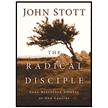 |
The Radical Disciple: Some Neglected Aspects of Our Calling By John Stott.
|
Reviewed by Jeff Romack.
“You call me ‘Teacher’ and ‘Lord,’ and rightly so, for that is what I am.” (John 13:13; NIV)
About six years ago New York Times Op-Ed Columnist David Brooks wrote of John Stott,
“When you read Stott, you encounter first a tone of voice. Tom Wolfe once noticed that at a certain moment all airline pilots came to speak like Chuck Yeager. The parallel is inexact, but over the years I’ve heard hundreds of evangelicals who sound like Stott.
It is a voice that is friendly, courteous and natural. It is humble and self-critical, but also confident, joyful and optimistic. Stott’s mission is to pierce through all the encrustations and share direct contact with Jesus. Stott says that the central message of the gospel is not the teachings of Jesus, but Jesus himself, the human/divine figure. He is always bringing people back to the concrete reality of Jesus’ life and sacrifice.” (NYT; 11/30/04)
Later, in that same piece, Brooks went on to lament that the media is actually the reason why so many people are misinformed about evangelical Christians. When the media puts forth windbags like Jerry Falwell and Pat Robertson as the principal evangelical spokesmen, rather than “real life people of faith” like John Stott, everyone is done a huge disservice.
This is interesting stuff coming from a non-believing Jewish fellow like Brooks. Based on my most recent encounter with John Stott in this his latest and last book, The Radical Disciple, I’d say Brooks got it right. Of course, Stott found his voice and pen quite some time ago. Many first learned of the faith and Stott in his classic, Basic Christianity, which has been in print for more than fifty years. With this most recent effort, we are not surprised to find the writing completely in character with the voice we have come to know and trust. For me this small new gem is compelling precisely because we know that Stott ventures to write only of that which he has personally taken onboard. The so-called neglected aspects of the disciple’s calling have very clearly not been neglected by this real life man of faith and for this reason he has our respect and attention.
In his preface to, The Radical Disciple, Stott explains the thinking behind the book’s title. He observes that there are different levels of commitment among Christians. In saying this Stott is being descriptive, not prescriptive. The difference lies, he says, in one’s being selective as to which areas one will actually follow Christ. The radical disciple is one that recognizes that Jesus is Lord and he or she, the disciple, is not. The radical disciple, therefore, relinquishes all selectivity based on personal preference.
In this book Stott addresses what he believes are eight often neglected areas or characteristics of discipleship, thus, the subtitle. These would be areas in which a radical disciple has abandoned claim to selective obedience. The eight characteristics considered are nonconformity, Christlikeness, maturity, creation care, simplicity, balance, dependence, and death. Each characteristic is considered in its own chapter.
When I survey the list all entries seem appropriate but only two, Christlikeness and maturity, are obvious no-brainers. Two more, dependence and death, would seem to be aspects of particular concern to one, like Stott, at an advanced stage of life. The others; nonconformity, creation care, simplicity and balance seem “relevant.” In his conclusion Stott admits that he has been selective in choosing these eight characteristics and somewhat arbitrary. Having said that and recognizing that other characteristics might also be suggested, it is clear that Stott believes these are aspects of discipleship appropriate for all Christians and ones he desires for himself.
Stott’s treatment of each of the eight characteristics is to the point. In his consideration of nonconformity and creation care he starts with a view to the world as it is by commenting on the challenges of pluralism and the ecological crisis. The chapter on Simplicity is good but has little original material beyond a brief story illustrating how a commitment to simplicity can lead to fruitfulness. Most of the chapter is made up of “An Evangelical Commitment to a Simple Lifestyle,” a document that came out of a consultation on the subject in 1980. While that’s not exactly fresh I can’t think of too many people that would not do well to read it and ponder. The other characteristics take the inward life of the disciple as starting point. All in all there is not much here to argue with but much to aspire to.
Stott’s writing is itself a great example of simplicity; clear, concise, straightforward and unadorned but never austere. He writes with an economy of words, saying in a few what others struggle to say in many. If ever less is more such is the case with The Radical Disciple. At a number of points I wanted the author to say more and half expected it. After all, so many books these days seem too long by half. By the book’s end; however, I was convinced that the brevity of Stott’s prose is one of the book’s strengths. In this regard The Radical Disciple is a vicotry of substance over style. For one thing, these days it seems that the standard format for books in the discipleship genre requires a laundry list of questions at the conclusion of each chapter over which the reader is meant to ponder. Honestly, with many of these books, at that point I’m not that interested or just too exhausted to go on. With this small book; however, each chapter serves as an effective launching point to further reflection and without the bother of programmed questions. In sum, Stott presents radical discipleship as a deeply inviting way of life and not just a matter of dogma to be argued or barriers to be hurdled.
In April of this year John Stott celebrated his 89th birthday. Since 2007 he has been retired from active public ministry. One chapter in the book; “Christlikeness,” is based on the text of his last public address given at the Keswick Conference in ‘07. At the conclusion of this book Stott informs us that he is now putting down his pen for the final time. A pen it is since Stott never gained immigrant status in this digital age but has remained a pen to paper holdover from the previous era. Technological change is one thing but discipleship is quite another. Following Christ in a rapidly changing world requires focus and discernment as to that which is essential and enduring and that which is not. Stott is one that understands this even as he nears his finish line. Those of us, and we are many, who have in some way been shaped for God’s purposes through John Stott’s life and ministry do well to ponder the words of the writer of Hebrews who counsels us to remember our leader who spoke the word of God to us and to consider the outcome of his way of life as one radical disciple .
“For I am already being poured out like a drink offering, and the time has come for my departure. I have fought the good fight, I have finished the race, I have kept the faith. Now there is in store for me the crown of righteousness, which the Lord, the righteous Judge, will award to me on that day—and not only to me, but also to all who have longed for his appearing.”
(2 Timothy 4:6-8; NIV)

C. Christopher Smith is the founding editor of The Englewood Review of Books. He is also author of a number of books, including most recently How the Body of Christ Talks: Recovering the Practice of Conversation in the Church (Brazos Press, 2019). Connect with him online at: C-Christopher-Smith.com
 Reading for the Common Good From ERB Editor Christopher Smith "This book will inspire, motivate and challenge anyone who cares a whit about the written word, the world of ideas, the shape of our communities and the life of the church." -Karen Swallow Prior Enter your email below to sign up for our weekly newsletter & download your FREE copy of this ebook! |
 Understanding Christian Nationalism [A Reading Guide]
 |
 Most Anticipated Books of the Fall for Christian Readers! Most Anticipated Books of the Fall for Christian Readers!
|
 Hilarious One-Star Customer Reviews of Bibles Hilarious One-Star Customer Reviews of Bibles |