
Reclaiming the Intersection of Protest and Prayer
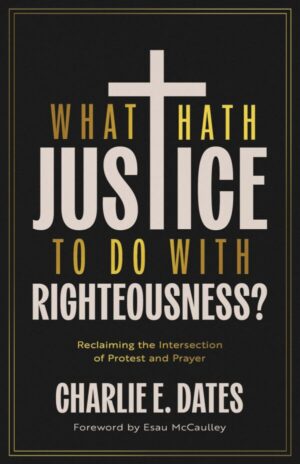 An Excerpt from
Charlie E. Dates
Paperback: IVP, 2026
Buy Now: [ Amazon ]
Righteousness and justice are two interdependent yet inseparable ideas in the heart, mind, and revelation of God in the Scripture. Like Table Mountain in South Africa, the pillars of righteousness and justice rise with unshakable authority, gazing down on the decisions of humankind. They are not merely good, admirable ideas; they are foundational to the mind and revelation of God. Our preaching of the gospel is directionless without them. Our coursework in the Christian academy, however rigorous, loses its edge outside of these. Our practice in the public square forfeits our credibility without them. However intellectual, moral, or devout we claim to be, these pillars expose our assertions and test the integrity of our doctrines.
For this reason, to be both righteousness- and justice-minded is to be more fully Christian, and to divorce the two from one another is to neglect our God-given responsibility and to abandon our Christian witness in the world. Fundamentally, the church cannot call just what is not righteous, nor can she call righteous that which is not just.
As revealed and defined by God, the two are inseparable and connected. To his people, they must be too.
A CHRISTIAN IMPERATIVE . . . NOT A SUGGESTION
I want to propose that justice is a necessary imperative for Christian living. No Christ-follower is permitted an excuse not to think justly, act justly, or do justice (Micah 6:8). The imposition of the just mind of God is not the burden of a select few. It is not the cadre of “social justice warriors” who are to bring God’s heart for justice to the public square. Scripture makes an inescapably clear argument that every person who names Christ as Lord has the consequential burden to fight for justice.
The good news is that justice is not a human construct. The bad news is that the church in America tends to treat it that way. By examining the biblical and theological tenets of justice, we can safely assert that justice is God’s idea. To reduce matters of justice to a variable of human ingenuity, a political personality or party, or an idea that is to be defined according to the present era of human history is to simultaneously dismiss the imperatives of Scripture. What is worse is to name justice—and the Christian’s command to live justly—as a scheme of Protestant liberalism.
Justice is an attribute of God made manifest in his dealings with Israel, the nations, and in the person and work of Jesus Christ. In a more perfect union, these biblical principles of justice should govern, administrate, and mitigate against the error of oppression. The best of Black preaching has proclaimed that the righteousness of God is manifest in his miraculous enactment of justice for his people. God’s righteousness and justice are the foundation upon which he orders his economy. Righteousness is more than a theological category we ascend to in the salvific movement. Righteousness is more than a mere term to parse.
Further, righteousness cannot be claimed apart from justice. Justice has its ground in the righteous character of God. That is to say, justice is God’s righteousness in action. It has been the failure of the Christian pulpit, academy, and mind to separate the two by relegating matters of justice as extracurricular to our faith. Anyone who does so is guilty of theological malpractice.
THE RELATIONSHIP BETWEEN RIGHTEOUSNESS AND JUSTICE
The words for justice and righteousness in the Old Testament are used in two primary ways, the meanings of each never totally absent from the other. Mishpat, the Hebrew word for justice, is typically thought of as a decision within a legal context, like a ruling. Tsedaqah, the Hebrew word for righteousness, is the act of setting things right, an alignment with the God-ordained created order. The interrelation is fascinating: Justice is an incarnation of righteousness, and righteousness is both the grounds for and fruit of justice.
These words remind us that God both cares about justice and does justice (Psalm 11:7; Isaiah 61:8). Righteousness and justice are the foundation of God’s throne (Psalm 89:14). His people praise him for his justice (Psalm 33:4-5). He chastens his people when they are unjust toward one another (Psalm 72:1-2; Isaiah 1:17, 21-23). They languish under the oppressive hand of unjust kingdoms and then they long for the appearance of the righteous judge who will bring an end to injustice and their enemies (Habakkuk 1).
The God of the Bible is a king who does not turn away from injustice and who desires to bring about justice. To this end, the language of righteousness and justice embodies the characteristics required to align our personal judgments and social living with God’s original intended order. When that happens, justice prevails and righteousness rules. When it does not, the oppressed languish with a need for a prophetic voice.
—–
Adapted from What Hath Justice to Do with Righteousness? by Charlie E. Dates. © 2026 by Jeremy Sims. Used by permission of Intervarsity Press. www.ivpress.com.
Charlie E. Dates (PhD, Trinity Evangelical Divinity School) is the senior pastor of Salem and Progressive Baptist Churches of Chicago. A sought-after speaker, he is widely invited to preach at churches, conferences, and universities throughout the United States and abroad. He is an affiliate professor at Baylor University’s George W. Truett Theological Seminary, Anderson University, and Wheaton College. He is a contributing author to the Handbook of Contemporary Preaching and Letters to a Birmingham Jail. He and his wife, Kirstie, and their children, Charlie II and Claire, live in Chicago.
 Reading for the Common Good From ERB Editor Christopher Smith "This book will inspire, motivate and challenge anyone who cares a whit about the written word, the world of ideas, the shape of our communities and the life of the church." -Karen Swallow Prior Enter your email below to sign up for our weekly newsletter & download your FREE copy of this ebook! |
 Understanding Christian Nationalism [A Reading Guide]
 |
 Most Anticipated Books of the Fall for Christian Readers! Most Anticipated Books of the Fall for Christian Readers!
|
 Hilarious One-Star Customer Reviews of Bibles Hilarious One-Star Customer Reviews of Bibles |