 “The early church taught…”
A Review of
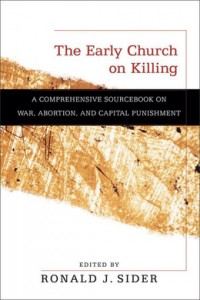
The Early Church on Killing: A Comprehensive Sourcebook on War, Abortion, and Capital Punishment.
Ron Sider, editor.
Paperback: Baker Academic, 2012.
Buy now: [ Amazon ] [ Kindle ]
Reviewed by Eddie Gonzalez.
If you read apologetic works or listen to Christian debates, you’re probably used to hearing the phrase, “The early church taught…” It’s a popular phrase, and no one group has a monopoly on it. The issue being talked about doesn’t have any bearing on its use either. Purgatory? Protestants will use it as much as Roman Catholics. Elder led churches or paid team of pastors? Both sides of that discussion are bound to use the phrase. The idea of killing–participation in war or the military, support for capital punishment, killing another human regardless of the circumstances–is another important issue where you will hear, “The early church taught…” The most difficult aspect of the statement, though, is that the early church was not an authoritative, monolithic group of people who all agreed on everything. They lived throughout an almost 300 year span. They lived in vastly different contexts within Europe and Asia at the time. They didn’t all hold to the same “orthodox” beliefs that “we” do.
Here is where Ronald Sider’s book comes into play. The title isn’t meant to disguise anything: The Early Church on Killing: A Comprehensive Sourcebook on War, Abortion, and Capital Punishment. Sider’s task was to compile “all extant data directly relevant to the witness of the early church on killing” (14). And that is what he did. What you find is a book of writings from the early church having to do with killing. Many are very much directly on topic. Others indirectly touch on the subject. What Sider has done is gather these passages into a single volume. There are a wide range of sources here: Athenagoras, Tertullian, Minucius Felix, Julius Africanus, Origen, Lactantius, and even The Infancy Gospel of Thomas, to name only a few. Along with the passages, he provided some context and helpful notes to help us get the point better. He was obviously trying to expand his audience to all levels of Christian readers: student, teacher, leader, layman; those who knew about St. Clement and those with no clue who Emperor Constantine was. He was even able to put this all together without allowing his biases (as a pacifist of the Anabaptist tradition) to negatively color his presentation of the “facts.”
The key to Sider’s text is the Afterword. If you don’t read those pages, you will miss the point the work. Yes, it’s a great resource to have such a comprehensive sourcebook on hand; to be able to turn to the relevant passages you need a lot quicker than if you only had your Ante-Nicene Fathers or your Loeb Library editions. But it’s in the Afterword where Sider presented his perspective on the passages, especially how to interpret and understand them practically. He summed things up, in a way. For example, after presenting the case for the early church’s witness on capital punishment, he wrote,
“The extant pre-Constantinian Christian comments on capital punishment that clearly refer to what Christians should or should not do, all say that Christians should not participate in capital punishment; it involves killing a person and Christians do not do that.” (168)
And, in what should be welcomed by all, he dealt with the difficult passages that some have argued challenge if not contradict his own pacifist, Anabaptist tradition. He spent time discussing the ambiguous texts, the use of military language, and even the passages that clearly talk about Christians being involved in the military before Constantine.
Even if you don’t need the collection of sources, packaged in such a handy way, the Afterword is a must. Ronald Sider made his case well for being able to say, “The early church taught…” with some authority, some real meat behind his words. And this is definitely a very welcome and helpful resource for any Christian’s library. The subject of killing is only going to continue to be a vital part of our conversations, no matter where we are. Abortion is always a hot button issue around election time. Capital punishment, as the abolishment movement continues in the US (and this November will be voted on in my state of California), is definitely getting discussed. War and whether Christians ought to participate in the military will always be a challenging conversation. The Early Church on Killing (if utilized) will definitely raise the level of the conversation, and help to quickly bring some clarity when someone says, “Well, let’s see what the early church actually said.”

C. Christopher Smith is the founding editor of The Englewood Review of Books. He is also author of a number of books, including most recently How the Body of Christ Talks: Recovering the Practice of Conversation in the Church (Brazos Press, 2019). Connect with him online at: C-Christopher-Smith.com
 Reading for the Common Good From ERB Editor Christopher Smith "This book will inspire, motivate and challenge anyone who cares a whit about the written word, the world of ideas, the shape of our communities and the life of the church." -Karen Swallow Prior Enter your email below to sign up for our weekly newsletter & download your FREE copy of this ebook! |
 Understanding Christian Nationalism [A Reading Guide]
 |
 Most Anticipated Books of the Fall for Christian Readers! Most Anticipated Books of the Fall for Christian Readers!
|
 Hilarious One-Star Customer Reviews of Bibles Hilarious One-Star Customer Reviews of Bibles |