
 A Conversation on Color from a Lexicographer
A Review of
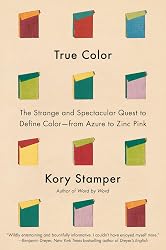
True Color: The Strange and Spectacular Quest to Define Color—from Azure to Zinc Pink
Kory Stamper
Hardcover: Knopf, 2026
Buy Now: [ BookShop ] [ Amazon ] [ Kindle ] [ Audible ]
Reviewed by Jamie A. Hughes
There are a lot of words for angry: annoyed, cross, enraged, exasperated, galled, indignant, or outraged, just to name a few. But none of them capture the hair-pulling, fist-pounding fury my 16-year-old son experienced his first (and only) time playing the game Hues and Cues.
On its face, the game seems simple enough. There’s a huge board of colored squares (480 different hues), and players score points by both giving accurate hints (as the cue giver) and making educated guesses. However, the ways we describe colors and the associations we bring to them aren’t quite as clear-cut as we think. That’s why the evening ended with my son repeatedly bonking his head on the table and wailing, “It’s so subjective!!”
Thanks to that fun family game-night moment, I was interested in True Color: The Strange and Spectacular Quest to Define Color—from Azure to Zinc Pink by Kory Stamper. The author is not a colorimetrist (a super nerd who specializes in the measurement and quantification of color) but a lexicographer (a foolhardy soul who writes, compiles, or edits dictionaries). She’s been writing dictionaries for three decades for Merriam-Webster, Cambridge Dictionaries, and Dictionary.com.
I was hoping for a delightful exploration of things like pigments, what natural elements have been used to create certain shades (like Scheele’s Green, a super bright pigment popular in the 19th century made using arsenic), how certain colors got their names, and how names changed over time. And while there was some of that in the early chapters of Stamper’s book—such as the history of the word “puke” and a fascinating footnote about “mummy brown” (which was made using a pigment “sourced from pulverized mummies”)—it was far more concerned with the struggles dictionary editors face when trying to define color.
And it’s not just a breezy intellectual history of words and the valiant efforts of people trying to keep the language surrounding color tidy. Fairly early on, the book does a hard right turn into biography, focusing on the obsessive personalities involved in the decades-long effort to define color across Webster’s Second and Third editions. (Seriously, there was more drama in the making of a dictionary than in an entire season of Dynasty.)
However, despite the kind of double bait-and-switch that came with this book, I still enjoyed reading it. Stamper’s writing style is funny and conversational, and while she does lean like a Great Dane into technical minutiae more than once, it’s balanced by a healthy supply of brief observations, asides, and footnotes that are laugh-out-loud funny. For instance:
- “There is a surprising—maybe even distressing—amount of literature on color standards for teeth.”
- “No matter how helpful a dictionary intends to be, there are still some editors who cannot but express themselves most obfuscatorily.”
- “It might have been that roping and wrangling a stable of geologists, chemists, physicians, botanists, biologists, and a Whitman’s assorted sampler of other scientific-ists meant Carhart didn’t have time to care.”
- On the hunt for a new editor in chief: “In short, they were looking for Jesus Christ, PhD, MBA.”
All in all, as a nerdy person who thrives on input, I eventually settled into and enjoyed this read. But I can easily see that not being the case with some folks. So if you’re into nebulosity, if you enjoy trying to understand highly abstract concepts, or if the vagaries of gloss paint are truly your bag (yes, there’s an entire chapter on that), this is definitely the book for you.
However, if you’re more like my kid, you may want to sit this one out.

Jamie A. Hughes
Jamie A. Hughes is a writer/editor living in Atlanta, Georgia with her husband, two sons, and a pair of needy cats. She has written for Christianity Today, The Bitter Southerner, CT Women, Comment Magazine, Ink & Letters, Fathom Magazine, The Perennial Gen, You Are Here Stories, and Restoration Living.
 Reading for the Common Good From ERB Editor Christopher Smith "This book will inspire, motivate and challenge anyone who cares a whit about the written word, the world of ideas, the shape of our communities and the life of the church." -Karen Swallow Prior Enter your email below to sign up for our weekly newsletter & download your FREE copy of this ebook! |
 Understanding Christian Nationalism [A Reading Guide]
 |
 Most Anticipated Books of the Fall for Christian Readers! Most Anticipated Books of the Fall for Christian Readers!
|
 Hilarious One-Star Customer Reviews of Bibles Hilarious One-Star Customer Reviews of Bibles |