
 A More Holistic Imagery
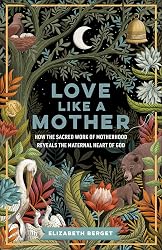
A Review of
Love Like a Mother: How the Sacred Work of Motherhood Reveals the Maternal Heart of God
Elizabeth Berget
Paperback: Brazos Press, 2026
Buy Now: [ BookShop ] [ Amazon ] [ Kindle ] [ Audible ]
Reviewed by Anna Rollins
When I was in graduate school studying linguistics, I was attending a complementarian church. Up until that point in my life, I had only ever worshiped in spaces where men were the sole arbiters of souls. But I was beginning to feel alienated and angry by the gender hierarchy. I struggled with the language of our liturgy: it was all so male-coded. God was King and Father, Husband and Master. And the masculine language wasn’t just limited to the divine: even when human beings were referenced it was “by one man sin entered the world.”
“Surely,” I argued with my pastor during a potluck, “we should use egalitarian language when we speak to the problem of the human condition.” “You know that man means human which includes woman,” my pastor would respond, when I challenged the negligent terminology. Still, I wanted to worship in a setting where I wasn’t too insignificant to name, where my identity – my sin, even – wasn’t consumed by man.
It is among those who feel spiritually unseen that Elizabeth Berget’s Love Like a Mother finds a hungry audience. Berget examines imagery of pregnancy, labor, delivery, loss, nourishment, care, and rest in the Bible. For women who have been taught to know God as father (with all of the attendant masculine qualities), it feels radically intimate to consider God through the work of a mother.
Berget’s book is guided by this question: “Does God love us like a mother?” Berget makes it clear early in the text that her inquiry does not discredit God as father. She is interested in a more holistic way of imagining God reflecting human image bearers. She writes, “If God, like a father, protected the Israelites in the wilderness, did he also feed them manna, like a mother? Could the invitation to be born again be more fully understood when we recognize that the God who invites us to know him as a father in Romans 8:15 is the same God who gave us birth, like a mother, in Deuteronomy 32:18?”
Berget weaves her analysis of Scripture with her own personal narratives as a mother of three children, along with stories from other mothers. Beginning with her own experience of pregnancy, she considers the image of a womb.
She examines this organ’s primary function: to protect and nurture. She reflects upon how a pregnant mother experiences a filled womb – with food cravings, back aches, sleepless nights, a relentless need to pee. It is in this specificity that the book engages in its most compelling analysis. Berget eschews romanticized, distant metaphors, and instead zooms in to consider them embodied and in context. She paints a portrait of a third-trimester God, counting every kick, dreaming of holding her child in her arms.
As a girl raised evangelical, I was quite accustomed to hearing the phrase “born again” in casual conversation. It felt radical to consider that same phrase – “born again” – through the lens of who has the ability to give birth: a mother. As Berget notes, children cannot birth themselves; it is the work of a mother. It is in the waters of labor – blood, sweat, tears, amniotic fluid – that creation is brought forth from the deep. A mother cries, “no more,” when she is at transition, on the edge of death to life. How miraculous to consider the mother-love of God bursting forth, breaking open, and crying “My God, My God,” just before the birth of our own spiritual lives.
Berget’s chapter on the mother-love of God in pregnancy and delivery helped me imagine my own life as gestating inside the womb of God. What if with each passing year of my human life, I was growing into a kind of fullness for the future? What if death was a kind of birth into new life, where I would be received with milk and comfort on the chest of God my mother? I’d considered the concepts of sanctification as growing into a fullness of spiritual life and of glorification as a new birth – but understanding these ideas through the physicality of motherhood transformed my conception from theoretical to real.
Berget continues to unpack maternal, spiritual imagery. We understand the sacramental nature of God as a breastfeeding mother whenever we take and eat the body and blood. The maternal mental load – the sheer neverendingness of the needs of children – helps us more fully realize God’s omniscience and omnipresence. In each example, it is made clear that neglecting the maternal imagery of God diminishes our understanding of divine love. It is through both male and female that God makes Godself known. Our embodied experiences on earth point us toward a greater understanding of holiness.

Anna Rollins
Anna Rollins is the author of Famished: On Food, Sex, and Growing Up as a Good Girl. Her groundbreaking debut memoir examines the rhyming scripts of diet culture and evangelical purity culture. Follow her on Instagram and Substack @annajrollins.
 Reading for the Common Good From ERB Editor Christopher Smith "This book will inspire, motivate and challenge anyone who cares a whit about the written word, the world of ideas, the shape of our communities and the life of the church." -Karen Swallow Prior Enter your email below to sign up for our weekly newsletter & download your FREE copy of this ebook! |
 Understanding Christian Nationalism [A Reading Guide]
 |
 Most Anticipated Books of the Fall for Christian Readers! Most Anticipated Books of the Fall for Christian Readers!
|
 Hilarious One-Star Customer Reviews of Bibles Hilarious One-Star Customer Reviews of Bibles |