
Am I Loved?
Timothy Jones on Loneliness, the Trinity,
and Being Fully Beloved
on intimacy with God in an age of isolation.

 Fully Beloved:
Meeting God in Our Heartaches and Our Hopes
Timothy Jones
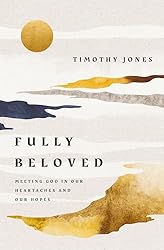
Paperback: Thomas Nelson, 2026.
Buy Now: [ BookShop ] [ Amazon ] [ Kindle ] [ Audible ]
Fully Beloved invites readers into a deeper, more personal understanding of God’s love – something many people are longing for in our divided and often overwhelming world. Why did you feel this was the right moment for a book that re-introduces readers to the intimacy of God’s love?
We live in a cultural moment plagued by epic, even epidemic loneliness. We may feel wearied from fractured relationships and polarizing conversations. We can forget how, nevertheless, at its core, living means relating. How we are relational through and through. A person is less an island and more an intersection. And sometimes it’s a small gesture that helps us: A barista’s upbeat comment gives our day a lift. Or a friend writes a note to thank us for the courage we showed in taking a stand. Someone we hurt says, “I forgive you.” A loved one’s face turns toward us with affection. Who doesn’t feel buoyed up by such reminders that we are cared for?
Relationships can also be complicated, of course. Even bewildering. And some of us grew up hearing voices that said, “You need to prove yourself.” We got a message that we have to earn affection. Or maybe someone you love rejects you, writes you out of their life, as happened to me.
Because we don’t always like ourselves, we go looking for connection or validation in ways that may not be healthy—refreshing our feeds, counting social media “likes,” chasing heart emojis, obsessing about status. Those habits only feed the distance and disconnection common in our lonely times.
And they never quite settle our nagging question: Am I loved? That three-word sentence is how I opened the book. It’s a question that aches within. And while I acknowledge that while we can do better at nurturing our daily friendships and community life, we also discover that human tenderness alone cannot satisfy our thirsting. We search for a communion that feeds the soul, a deeper experience of affection that seems more reliable, sturdy—an abundant, stubborn love.
You write about the Trinity not as a dusty doctrine but as a “society of intimate relating.” For someone who finds the concept of the Trinity complicated or distant, how does this book serve as a gentle invitation to see it differently?
The Trinity show us that God has more relatability up his sleeve than maybe we thought. That will be news to some. People are mostly comfortable, I find, with Father, Son, and Holy Spirit—those we can name and nod along to. But talk of the Trinity? Things start to feel intimidating. Isn’t it mostly a puzzle meant for pastors, professors, and the occasional brave soul with a diagram? Yet I’ve long known that believers, ancient and contemporary, have found in such naming utter delight. Which led me to go deeper. Rather than complicating our experience of God, glimpsing God as Father, Son, and Holy Spirit can warm it, can change us.
For here we see a God who has always lived in perfect relationship and love, and who now welcomes us into that love, meeting us in our hunger, inviting us closer.
From my pastoring and praying, grieving and wrestling, I set out to share discoveries that the Trinity is not an abstract belief but a startling, extravagant gift—living help amid our brokenness—and an assurance. It’s a way to say God is more understanding of what it means to be human than we comprehended.
The book is filled with deeply personal stories of heartache and hope, including your own. Why was it important for you to be so vulnerable, and how do you believe that helps readers connect with the idea of being Fully Beloved?
Because the eternal life of God bears on the mundane and grubby particulars of every life, the sorrows as well as the highs, I’ve been eager to catch signs of the fellowship of the three showing up where I live.
The last thing the world needs is a catalog of spiritual platitudes or vague maxims, detached from everyday struggles. So I tried to write in a way that was, as one early reader put it, unflinchingly honest. I turned often to such stories. One of the hardest turns in my life, for instance, came with my parents’ rejection of me as a young adult. I still recall the letter I got from them when I was in seminary, asking me to send back my house key, stressing I was no longer welcome there. And there have been others losses I write about. I’m convinced that such pains in our relating—small and almost forgotten or still looming large—affect us over the years. Our heart feels tender-sore instead of tenderly held.
You write with such compassion about suffering. How does God’s willingness to enter into our pain, rather than just observe it, change how we should view our own seasons of grief and loss?
God does not simply look from afar. Rather, he draws near to share our griefs. In the Incarnation, God steps into our world’s brokenness and gritty realities. Thank goodness. From then on, everything he says and does binds him more closely to the raw, unvarnished grit of ordinary life. For the Second Person of the Trinity not only suffered physically in his journey to the Cross but also, plumbing the depths of humankind’s worst, was strung up—the rejection utter and complete. The cross served not only an instrument of torture, but, as someone put it, a theater of humiliation. Jesus cried out to God in seeming forsakenness. He died.
There’s mystery here. And miracle. For he did it for us, in the face of cosmic evil. He came into a war-seared world. Came amid our stupid, unfathomable meanness. He walked through it all, to the other side. That scene centuries ago, as we will soon ponder on Good Friday, doesn’t answer all of the questions about rejection and loss and suffering and death. But we know because of it that we are not God-forsaken. Decidedly not bereft and alone.
You beautifully weave together insights from ancient figures like Julian of Norwich with very contemporary struggles. You pull in the questions and discoveries of poet Emily Dickinson. What can these voices from the past teach us about navigating the anxieties of our current world?
Because there’s more to discover than what we get from newsfeed headlines, podcasts, or the celebrity of the day, I wanted to include older, tested voices in the conversation—voices who speak of their spiritual discoveries. Ancient wisdom from the likes of Augustine has given me a lot to ponder and pray about.
And in the searching questions of a poet like Emily Dickinson I’m seeing something ageless and compelling. And Julian, the medieval pray-er? She exalted, “The Trinity suddenly filled my heart full of the utmost joy; and the Trinity is our unending joy and bliss.” We stand to learn from such voices.
If a reader is finishing your book and feeling a renewed sense of being treasured by God, what is one practical change you hope they make in how they interact with others the very next day?
It’s easy, isn’t it, to fall into a comparison game? Online media does not help this temptation. We measure our work successes—or our vacations—against the curated milestones of our internet world—sunshiny, beach-lit smiles of neighbors or colleagues. This isn’t about community; it’s about thinking we can prove our worth or improve our standing. We compete, adding to a toxic climate frayed by division. We pursue status when what we really want is belonging. But I’ve discovered freedom here, freedom from self-recrimination. The immense love in the Trinity puts our striving into perspective.
You discuss the Holy Spirit as a “lively, life-giving, electrifying Presence.” For someone who feels their spiritual life is more stagnant than electric, what’s a first step toward becoming more alert to the Spirit’s movement?
I hear people sometimes call the Holy Spirit the “shy” member of the Trinity. I have a different take. Many of the images for the Spirit in the New Testament’s depiction of Pentecost are visceral: fire; a dove descending; a blustery, even violent, wind. A galvanizing breath. The disciples can’t sit still or stay quiet. The words of the earliest disciples ignited with fiery passion. If they came around today, they wouldn’t just spread the word; they’d set off smoke alarms.
Maybe best of all, the Bible calls the Spirit the Advocate, someone in your corner when things get terrifying or distressing. The effects are sometimes gentle or the Spirit may overwhelm us with immediacy. He can move us from where we’ve been stuck, pierce our bubbles of isolation, and incorporate us into the communality and the life of the Trinity.
And this activity can lead to a new sense of competence in place of weariness, a deeper capability to love others in place of wariness. We find life filled anew with renewed conviction about our belovedness, leaving us, in ways we might now barely imagine, with more to share with others.
What is one surprising thing you learned about God or yourself while writing Fully Beloved?
That I’m less alone than I feared. That I’m more loved than I thought. That the God of boundless love seen in the Trinity holds me and the world in a strong and sure embrace.
Timothy Jones is a pastor and author known for helping people uncover greater warmth and depth in their relationship with God. His writing, Sandra McCracken wrote, “names our loneliness and lifelong quest for belonging,” while “with honesty and relatability he invites us to encounter the God of divine love.” Tim is a blogger (www.revtimothyjones.com), Substacker, retreat leader, and author. He has written regularly for the Rabbit Room, Inkwell, Mockingbird, and other publications. His books include The Art of Prayer: A Simple Guide to Conversation with God and Awake My Soul: Practical Spirituality for Busy People. His latest, Fully Beloved: Meeting God in Our Heartaches and Our Hopes, explores God’s triune love set amid our human, everyday brokenness. Tim has presented at Inkwell, Hutchmoot, and, this spring, the Mockingbird conference in NYC. He enjoys all kinds of stories and playing old-time banjo with friends. He lives with his wife, Jill Zook-Jones, near Nashville.

C. Christopher Smith is the founding editor of The Englewood Review of Books. He is also author of a number of books, including most recently How the Body of Christ Talks: Recovering the Practice of Conversation in the Church (Brazos Press, 2019). Connect with him online at: C-Christopher-Smith.com
 Reading for the Common Good From ERB Editor Christopher Smith "This book will inspire, motivate and challenge anyone who cares a whit about the written word, the world of ideas, the shape of our communities and the life of the church." -Karen Swallow Prior Enter your email below to sign up for our weekly newsletter & download your FREE copy of this ebook! |
 Understanding Christian Nationalism [A Reading Guide]
 |
 Most Anticipated Books of the Fall for Christian Readers! Most Anticipated Books of the Fall for Christian Readers!
|
 Hilarious One-Star Customer Reviews of Bibles Hilarious One-Star Customer Reviews of Bibles |