
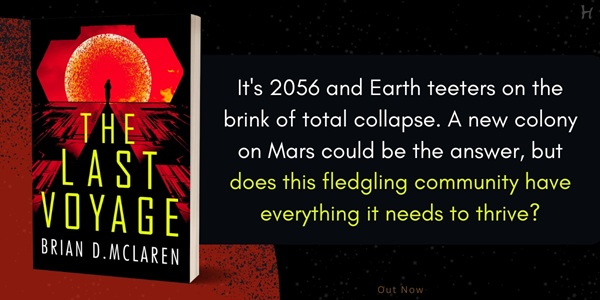
 The Last Voyage: A Novel
Brian McLaren
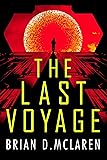
Paperback: Hodder Faith, 2025
Buy Now: [ Amazon ]
Gabriela Mercedes Coroy glanced at her eyes in the rearview mirror. Strange to see, she thought. Tears. Everyone thinks of me as smart and cheerful.
For the first time in her twenty-seven years of life, Gabriela had lied to her mother. Forever this would be true: that her final conversation with her mother was a lie.
She tried to reassure herself as she drove through the old neighborhood toward the highway, dodging skinny dogs and bags of trash in the rutted gravel road. It was only una mentira piadosa, a white lie, a pious lie, she told herself.
She turned south onto CA-1, following the faded sign for Guatemala City.
She tried to reassure herself. If her mother knew the truth, many lives would be at risk.
All the world’s poor knew what Gabriela and her mother knew: that the world was ruled by oligarchs.
The oligarchs themselves were connected to one another by networks of threat and obligation, and their networks were intertwined with global crime syndicates, not to mention local criminals, private militia, and, of course, pliable political parties.
Nearly every oligarch on Earth was surrounded by this nervous, eager, nodding flock of yes-men who gained a fortune and lost their souls by telling their bosses what they wanted to hear. As a result, most oligarchs lived inside invisible bubbles of narcissism.
Yes, there were a few clear-minded exceptions, and they were the ones who worried Gabriela. These outlier oligarchs knew that the jig would soon be up for them, as for everyone. The global ecosystem that had taken billions of years to evolve had tilted suddenly into disequilibrium, a victim of human over-shoot, and soon the highly profitable economic pyramid maintained by and for the oligarchs would collapse and decay like a corpulent corpse.
That’s why information on how to escape the coming catastrophe was, for the savvy, the most valuable commodity on Earth.
And Gabriela was one of the few who held this information. She had been chosen as one of the ten for the last voyage.
That’s what put her mother in such danger.
Gabriela instinctively hunched her shoulders and gripped the steering wheel more tightly as she felt again the precarious nature of the situation she had brought her mother into.
She reached up a hand to touch her necklace. Each simulated gemstone hid a cyanide tablet she could bite into and swallow if she were captured. A similar bracelet dangled from her wrist. She had been given permission to make this visit on the condition of wearing this deadly jewelry. It was worth the risk to see her mother one final time.
More frightening to Gabriela than biting a fake gem filled with real cyanide: at this very moment, an oligarch’s emissary could be pulling up to her mother’s house.
She tried not to imagine the scene: his fancy car, anonymously white, so out of place in front of her mother’s humble casita in Chimaltenango . . . his manicured hand stretching out from an expensive suit, knocking on her door with some lie of his own, pretending to be a reporter, or an official from the Guatemalan government, or perhaps someone from Gabriela’s lab in Boston. He would speak perfect Spanish. He would be cradling a breath mint between his upper teeth and cheek. He would smile and compliment her for her beauty, for her immaculate home, for her pretty pink flower box at the front door. He would ask for information about Gabriela’s whereabouts, politely at first, but that would change when he didn’t get what he was looking for.
Her mother was incapable of deceit. That’s why Gabriela had
to tell her mother a lie so convincing that she would repeat it with complete sincerity. It was Mami’s ignorance and purity that would save them both.
I am not so pure, Gabriela thought, not so innocent.
Gabriela had rehearsed the lie a hundred times before telling it, and now she reviewed it one last time: Un oligarca de Colombia me ha contratado para dirigir un programa secreto de investi-gación cientifica, she had said, feigning pride and happiness. An oligarch wanted her to use her skills in genetic engineering to help save coral reefs in the Caribbean, and he would pay her extravagantly. Es una oportunidad tan emocianante!
Gabriela tried to comfort herself with the rationalization that there was some truth to the statement. She was indeed going away on a voyage, and an oligarch of sorts was involved, and coral would even be a minor character in the story.
Why did she have to add that little joke? “No te preocupes, Mami. No es como si me fuera a Marte,” Gabriela had laughed when she said it: Don’t worry, Mom. It’s not like I’m going to Mars!
“Es peligroso trabajar por esas personas,” her mother warned, but smiling as she did so: it’s dangerous to work for those people. But instead of discouraging her only child from going, she gave permission with her favorite motherly advice: “Ten cuidado, querida. Vuelve segura.” Be careful, beloved. Come back safe. And then she added, “Siempre me haces sentir orgullosa.” You always make me proud.
That, of course, was the one desire that most shaped Gabriela’s life: to make her mother proud, to bring her joy. And when a large sum of money showed up in her mother’s bank account shortly after Gabriela’s disappearance, it would fulfill another great desire: to keep her mother safe, just as her mother had always done for her…
Just over an hour later, she pulled into the parking lot of her shabby hotel near La Aurora airport. She was still sniffling, still trying to convince herself that the lie she’d told was, if not morally justifiable, at least a necessary evil.
That’s all that’s left to us these days, she thought, the lesser of evils. What a world.
She sent a message on her bracelet: Ready for pickup. For ten minutes, then twenty, she sat on the side of her bed and stared out the hotel window across the blue smoky hills of her beautiful country, simply gazing, hardly thinking. Pollution, fires in the hills . . . the smoke seemed worse every time she returned to visit her mother.
She went to the bathroom to splash water on her face. As she held a threadbare pink hotel towel to her face to let it dry, she felt a ping in her implant.
She still wasn’t used to the implant in her ear. Implants were a luxury of the rich, as were com bracelets. She never could have imagined having either of these technological luxuries when she was a little girl in the barrio back in Chimaltenango.
Her bracelet shivered. Silva was waiting out front, the screen said, waiting in a black sedan. Our staff will pick up the rental car. Just leave the key at the front desk, it said.
Purchase this novel here.
©2025 Hodder Faith. Reprinted with permission. This article may not be reproduced for any other use without permission.

C. Christopher Smith is the founding editor of The Englewood Review of Books. He is also author of a number of books, including most recently How the Body of Christ Talks: Recovering the Practice of Conversation in the Church (Brazos Press, 2019). Connect with him online at: C-Christopher-Smith.com
 Reading for the Common Good From ERB Editor Christopher Smith "This book will inspire, motivate and challenge anyone who cares a whit about the written word, the world of ideas, the shape of our communities and the life of the church." -Karen Swallow Prior Enter your email below to sign up for our weekly newsletter & download your FREE copy of this ebook! |
 Understanding Christian Nationalism [A Reading Guide]
 |
 Most Anticipated Books of the Fall for Christian Readers! Most Anticipated Books of the Fall for Christian Readers!
|
 Hilarious One-Star Customer Reviews of Bibles Hilarious One-Star Customer Reviews of Bibles |